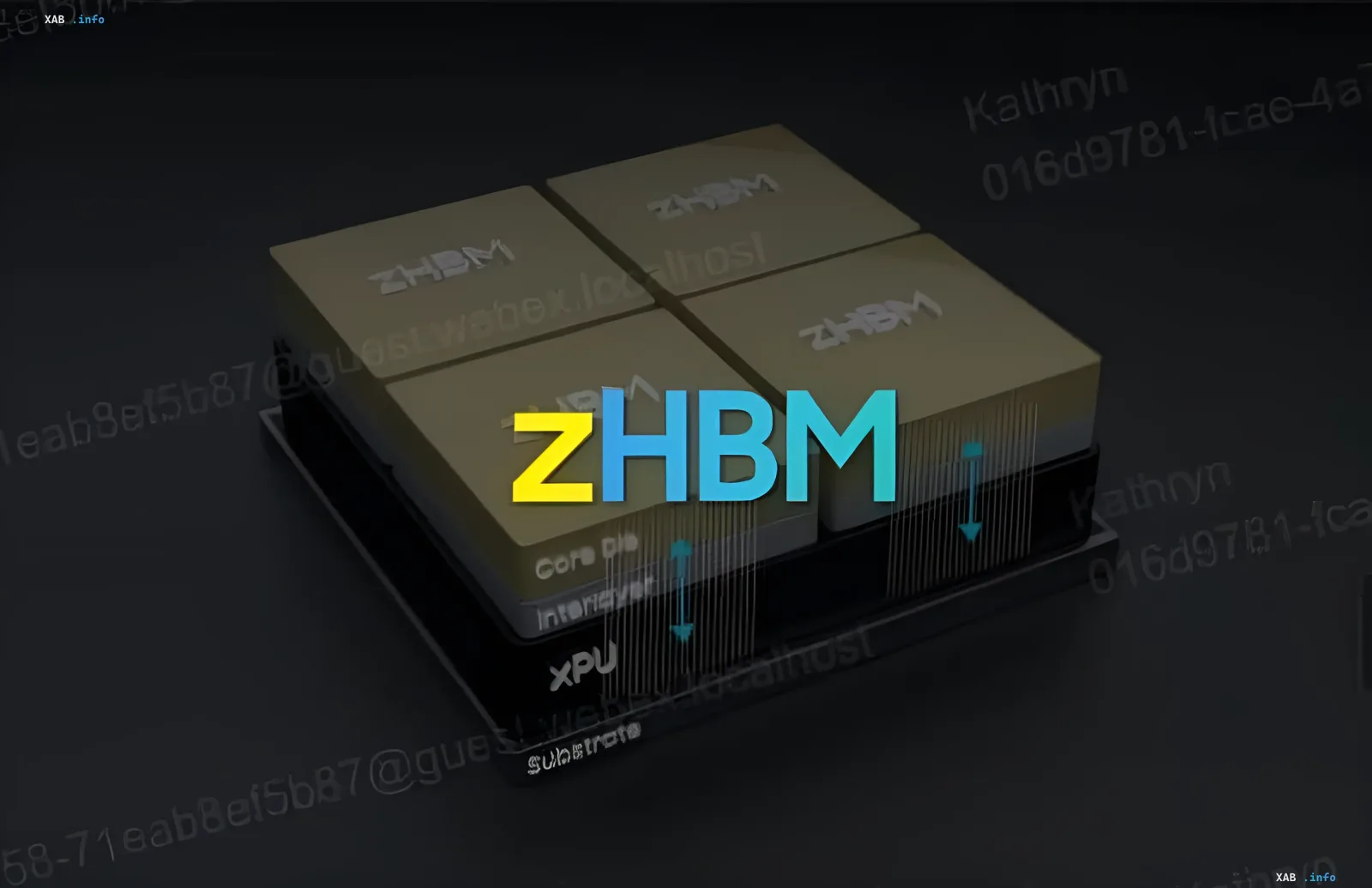
South Korean tech giant Samsung Electronics unveiled a series of advanced developments at the Future of Memory and Storage (FMS) 2026 conference, aimed at meeting the growing needs of the artificial intelligence industry. The centerpiece of the presentation was the demonstration of a new memory architecture — zHBM (z-High Bandwidth Memory).
Technological Breakthrough: zHBM
According to official company statements, zHBM represents an evolution of existing high-bandwidth memory (HBM) standards. The visualization of the technology presented at the event demonstrates a complex multi-layer structure, including Core Die, Interposer, and XPU, indicating vertical integration of components to minimize latency and maximize data transfer speeds.
The key advantage of the new architecture is a significant increase in storage density. According to Samsung, zHBM provides a 58% increase in density compared to the previous generation V9 V-NAND. This is critical for modern data centers, where physical space and energy efficiency play a decisive role.
Context: The Race for the AI Market
The announcement of new technologies comes against the backdrop of surging demand for computing power for training neural networks. Experts note that the AI memory market is valued in the trillions of dollars, and Samsung is actively fighting for leadership in this segment by offering solutions capable of outperforming current HBM5 standards.
In addition to zHBM, the company demonstrated other concepts:
- zNAND-O: A specialized solution for edge artificial intelligence systems (Edge AI).
- HBM4E and HBM5: Updated versions of high-bandwidth memory.
- LPDDR5X-PIM: Memory with processing-in-memory capabilities.
- SSD PM1763 and BM1773: Next-generation enterprise drives.
Contradictory Data
Various sources covering Samsung's presentation show discrepancies in performance comparison details. While some reports (including the primary material) focus on comparing zHBM with the V9 V-NAND generation, noting a 58% density increase, other analytical reviews suggest that this technology is intended to compete directly with HBM5, offering higher read and write speeds.
There is also uncertainty in terminology: some sources interpret zHBM as a full-fledged commercial product ready for release, while the company itself positions it as a future concept without revealing exact market launch timelines.
Commercialization Status
It is important to note that at this time, zHBM and several other presented developments remain at the stage of conceptual demonstrations. Samsung has not provided exact timelines for the start of mass production, chip pricing, or details of their compatibility with existing artificial intelligence accelerators (GPU/TPU).
Nevertheless, the emergence of zHBM signals that the memory industry is moving towards even denser integration and specialization for AI tasks, which will inevitably lead to a new round of the technological race between leading chip manufacturers.