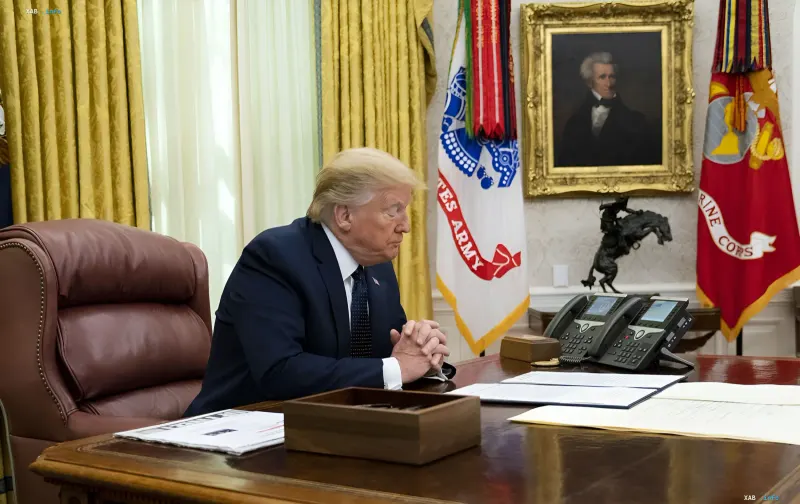
A new strategy for pressuring Moscow is taking shape in Washington, which differs radically from the usual automatic restrictions. The new bill, named after the late Senator Lindsey Graham, does not contain a strictly fixed list of prohibitions. Instead, the document provides the current US President, Donald Trump, with a unique tool of flexibility — the ability to independently select measures of impact from a wide range of options.
A "Sanctions Menu" for the White House
As Vladislav Vlasjuk, the President of Ukraine's Commissioner for Sanctions Policy, stated on the Telethon, the essence of the initiative lies in giving the executive branch freedom of maneuver. According to him, a kind of "sanctions menu" is opening up before Donald Trump.
"Overall, it is a sort of 'sanctions menu' from which President Trump will have to choose certain measures and apply them," Vlasjuk explained. He emphasized that the bill covers a wide range of possible restrictions, offering a huge number of different tools to choose from. This allows the US administration to adapt pressure to a specific geopolitical situation without being tied to template solutions.
The Path to Adoption: From the Senate to the House of Representatives
The history of the document began with active lobbying efforts. On July 28, the US Senate supported a bill to tighten sanctions against Russia and Iran. One of its key co-authors was the late Republican Senator Lindsey Graham, whose name the initiative now bears.
An important role in promoting the document was played by the visit of Ukrainian President Volodymyr Zelenskyy to the US. The head of the Ukrainian state held a series of meetings with more than 60 senators. According to Zelenskyy, the new bill has a dual significance: it serves not only as a tool to increase pressure on the Kremlin but also as an important signal for European countries.
Media reports indicate that it was Zelenskyy, together with Finnish President Alexander Stubb, who managed to convince American lawmakers to support the initiative, which is already being called "hellish sanctions" in the press.
Expectations and Timelines
Despite support in the upper house of Congress, the document has not yet become law. It still faces another vote in the Senate, which is planned to be held before the end of August. After that, the bill will be sent to the House of Representatives for consideration.
Vladislav Vlasjuk expressed confidence that the US Congress could finally approve the bill on "hellish sanctions" against the Russian Federation as early as early autumn. If this happens, Donald Trump will have a powerful and flexible lever of influence over the Russian economy and politics at his disposal.