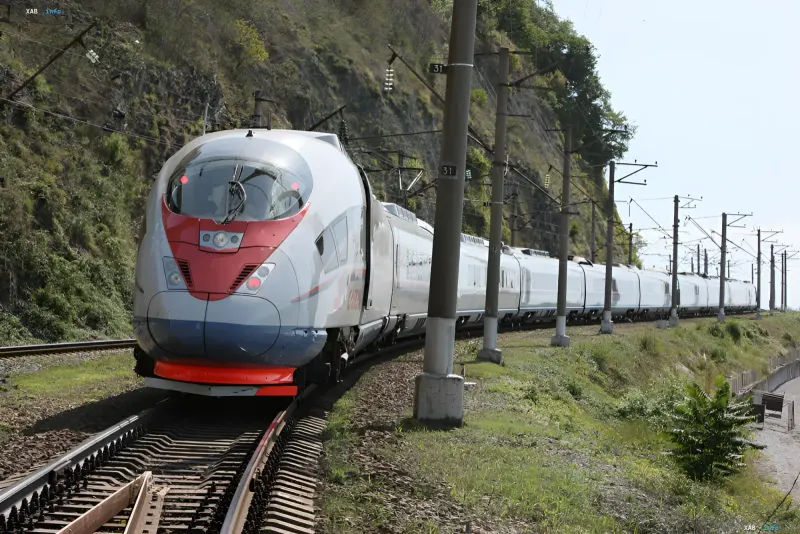
Russian Railways (RZD) has completed another stage of field tests for the high-speed Sapsan train on a specialized proving ground. As reported by RZD CEO Oleg Belozerov, the electric train completed 210 runs at speeds of up to 230 km/h on the Sablino — Tosno test section. The objective was to inspect the railway track design that will serve as the foundation for the future High-Speed Rail (HSR) line connecting Moscow and Saint Petersburg. Essentially, the test site is used to evaluate not the rolling stock characteristics, but rather the behavior of the track under high-speed load.
Proving ground as a "scientific center": 1500 sensors and over 35 TB of data
To gather information on track conditions, 1500 sensors were installed at the test facility. During the 210 runs, specialists acquired over 35 terabytes of data, which will allow for a detailed assessment of how the railway bed performs at high speeds. Oleg Belozerov described the test section as "effectively a scientific center," emphasizing that this was a systematic study rather than one-off test runs. The resulting massive dataset will form the basis for the design and subsequent operation of the main line.
Route and operation mode of the future main line
According to RZD, the future HSR will pass through six regions: Moscow, Saint Petersburg, as well as the Moscow, Leningrad, Novgorod, and Tver regions. The line is designed exclusively for passenger transport — freight traffic is not planned. During peak hours, trains are scheduled to depart at 15-minute intervals, which should ensure high capacity and reduce travel time between the two capitals.
Sapsan's speed potential
It is worth noting that the demonstrated 230 km/h is far from the train's ultimate capabilities. The operating speed of the Sapsan is up to 250 km/h, while the design (technical) speed reaches 300–350 km/h, depending on the model and specifications. Thus, the tests at the proving ground were conducted with a significant speed margin, allowing for the collection of data on track behavior in conditions close to real operation without pushing the equipment to its absolute limits.
The outcome of this stage is a confirmed volume of measurements and practical experience of high-speed movement on a real section. According to RZD, this data will form the basis for further work on the creation of the Moscow — Saint Petersburg High-Speed Rail.