
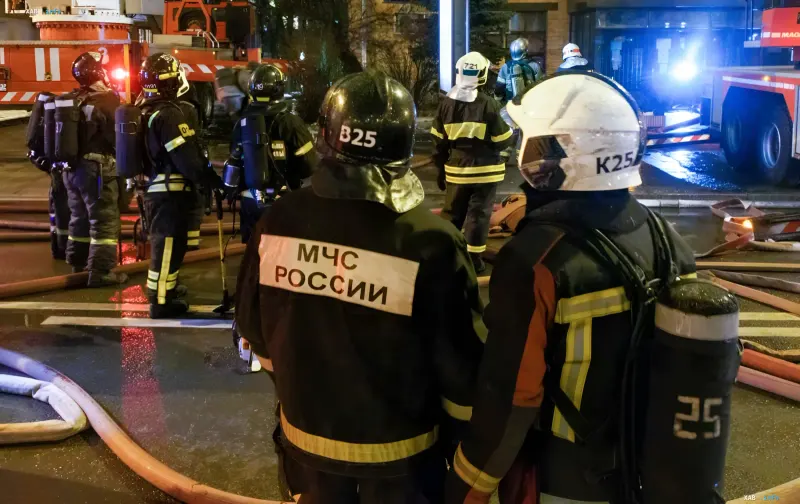
On the night of September 11, Saratov Oblast came under a drone attack. According to available data, fires were recorded at at least two facilities in the regional capital — an oil refinery and, according to preliminary information, an OZON logistics hub. The region's governor, Roman Busargin, confirmed that civilian infrastructure was damaged as a result of the attack. The incident is not the first such attack on the region in recent times.
Timeline of the Night Attack
At around 02:00, the governor of Saratov Oblast, Roman Busargin, reported that the Russian Ministry of Defense had provided information about the threat of drone use. According to him, "locally, in areas of possible threat, alert systems may be operating," and all emergency services were put on full alert. From 02:30 onwards, videos of a large-scale fire were widely spreading on social media, and OSINT channels clarified that a local oil refinery had caught fire as a result of the drone attack. About an hour later, channels reported that, preliminarily, in addition to the refinery, a fire had broken out at an OZON logistics hub. Information about explosions in Engels was also mentioned separately, however, at the time of publication, there was no confirmed data that anything had been attacked there.
What Is Burning: The Refinery and the Logistics Hub
According to reports from Ukrainian media and OSINT channels, the main strike hit a strategic oil refinery, which, according to several publications, is an asset of Rosneft. At the same time, there were reports of a fire at an OZON warehouse hub. Thus, in a single night episode, both energy/fuel infrastructure and a logistics facility were affected. The exact number of drones shot down or fallen was not officially disclosed.
Official Position of the Authorities
The regional authorities followed a sequence characteristic of such situations: first — a warning about the threat and putting services on alert, then — confirmation of the actual consequences. Governor Busargin ultimately confirmed that damage to civilian infrastructure was recorded as a result of the drone attack. At the same time, at the time of publication, no specific details about casualties, the scale of destruction, or the causes of the fires were officially provided, and information about explosions in Engels was left without comment.
Contradictory Data
There is a gap between the governor's initial statement (only about the "threat" and the readiness of services) and subsequent reports of specific fires at the refinery and the OZON hub: the precise identification of the targets was provided primarily by OSINT channels and media, not by an official source. The figures also differ: the publication from-ua.org speaks of "more than 15 drone attacks," while in other materials and in the governor's statement the specific number of strikes is not specified. Separately, one source (focus.ua) names the type of drones used — "Lyutye" — which is not confirmed by other materials. Finally, information about explosions in Engels remains unconfirmed. All these discrepancies are reflected in the text as preliminary.
Context: Repeated Strikes on Saratov
The night of September 11 is not the first such episode. On the night of September 8, Ukrainian drones had already attacked Saratov, including the refinery: residents reported explosions and a fire, and the governor confirmed damage to civilian infrastructure. According to available data, Saratov has been subjected to strikes multiple times, and the local refinery, starting from August 2, has halted operations for the second time. The repetition of attacks on the same facilities points to a persistent vulnerability of the region's fuel and logistics infrastructure.