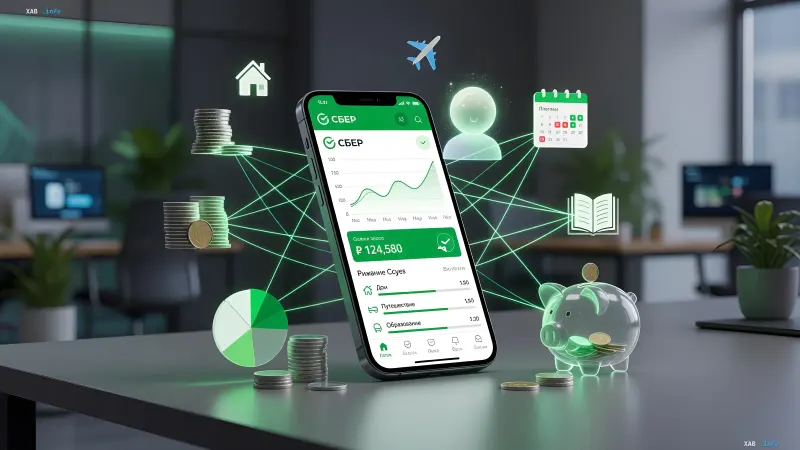
At the Investor Day held on November 12, 2026, Kirill Tsarev, First Deputy Chairman of the Executive Board of Sberbank, announced the company's plans to launch a new intelligent financial assistant. The service will be built on the company's proprietary large language model, GigaChat, and integrated directly into the Sberbank Online mobile app. According to the developers, the assistant is designed to handle routine financial tasks and help users achieve long-term goals, from savings to major purchases. The announcement was made during a presentation on the bank's digital product development strategy and was one of the key highlights for the investment community.
From disparate functions to a unified financial management system
The key differentiator of the new assistant compared to existing Sber tools is its architecture. While current services operate in silos (one analyzes spending, another evaluates portfolios, a third identifies tax deductions), the new agent will integrate the user's income, liabilities, and financial plans into a single, cohesive system. The client defines the goals and makes key decisions, while the AI handles the analytical and operational burden: data processing, selecting options, comparing terms, and executing routine transactions. Thus, the interaction model is based on the principle of "human as strategist, machine as executor," which, according to bank representatives, reduces the cognitive load on the user without relinquishing control over their money.
Twelve million users as a starting point
Kirill Tsarev emphasized that the new product is not being built from scratch: Sber's ecosystem of AI services already has a stable user base. According to the bank, more than 12 million clients use existing AI assistants every month. These include a service for analyzing spending and identifying savings opportunities, an investment assistant for portfolio assessment and rebalancing, and a tool that automatically identifies expenses eligible for tax deductions. These three areas will essentially become functional modules of the new unified agent, reducing development time and accelerating time-to-market.
Third-party services and the explicit consent principle
Particular attention was paid to extensibility during the presentation. In the future, Tsarev noted, the AI agent will be able to connect third-party services—ranging from insurance companies to online education platforms—with the user's explicit consent, performing approved actions within their interfaces. This means the assistant could evolve from an internal banking tool into a full-fledged digital financial representative working within an ecosystem beyond the bank itself. Notably, any step exceeding standard Sberbank Online operations will require separate client confirmation, which the bank states adheres to principles of transparency and control.
Context: Competition in the AI financial assistant segment
The launch of Sber's new assistant comes amid active adoption of generative AI in the banking sector. Major Russian and international banks are already testing similar solutions, ranging from chatbots answering product questions to agentic systems capable of making payments and managing subscriptions independently. With its own GigaChat LLM stack and the country's largest retail client base, Sber has the opportunity to scale agentic AI to an audience of tens of millions. For investors attending Investor Day, this signals that the bank views AI not merely as a support tool, but as a core element of the next-generation client experience.