An internal Sberbank analytical memo, leaked online by the hacker group Black Mirror, outlines eight scenarios for ending Russia's war against Ukraine. According to the document, obtained from the correspondence of the bank's head German Gref, the probability of a decisive Russian military advantage stands at just 7%. This is reported by RBC-Ukraine, Delfi and TheIns, citing the published text. The memo documents the deep economic and military problems facing Moscow and offers a detailed breakdown of possible trajectories for exiting the conflict — from a frozen front to a peace treaty with territorial concessions.
Economic pressure: budget deficit and collapse in oil and gas revenues
Sberbank analysts cite a series of alarming macroeconomic indicators pointing to growing stress in the Russian economy. The budget deficit for the first quarter of 2026 reached 4.58 trillion rubles (about $55 billion), while the annual plan was 3.8 trillion rubles ($45.6 billion). The key interest rate is held at 15%, and oil and gas revenues have fallen by 45.4% — to 1.44 trillion rubles (roughly $17.3 billion). Particular attention in the memo is given to the consequences of Ukrainian strikes on energy infrastructure: 10–15% of oil refining capacity has been damaged, creating long-term constraints on export potential and the domestic fuel market.
Military losses and structural deficits in the defense industry
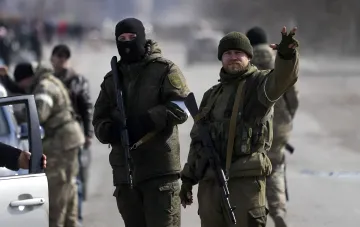
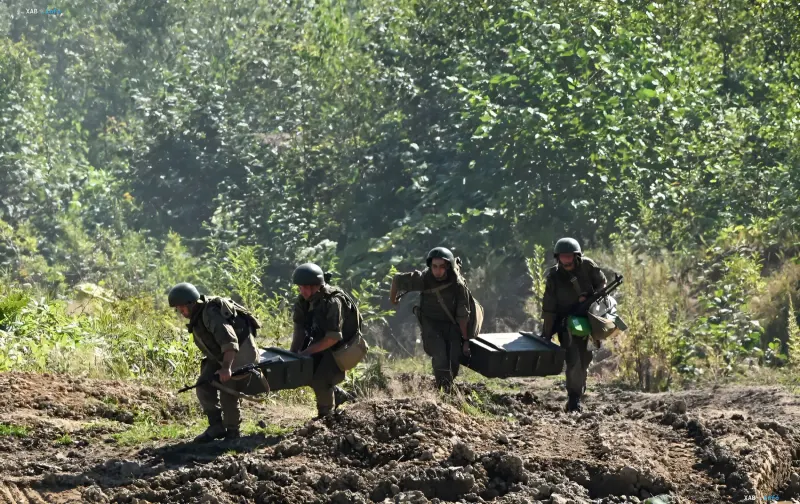
The military section of the document describes systemic problems in Russia's defense sector. The defense industry, according to the authors' estimates, is short by 80,000 to 400,000 workers, and there is a critical shortage of microelectronics, ammunition and engines. Russia has lost up to 35% of air defense system components, while monthly military losses are estimated at 20,000–25,000 people. Around 90% of new contract soldiers, according to analysts' calculations, are being sent solely to replace these losses, indicating the army's inability to shift to offensive operations without significant reinforcement. According to the memo, troop advances amount to roughly 100–200 meters per day — a pace the authors characterize as "exhausting."
Eight scenarios: from "decisive superiority" to "peace on Kyiv's terms"
The document distinguishes eight scenarios for ending the conflict. The most likely for Russia is the "decisive military superiority" scenario, with a probability of 7% and a horizon of 12–24 months: Russia gains control over Donetsk, Luhansk, Zaporizhzhia, Kherson and Kharkiv oblasts within their administrative boundaries. Implementing this scenario requires mobilizing 300,000–500,000 people, increasing the production of aerial bombs, strengthening air defense, and a breakthrough in creating autonomous drone swarms coordinated via AI without operator involvement. Preconditions cited include falling support for Ukraine in the US below 30%, an energy crisis in Europe in the winter of 2026–2027, and a domestic political crisis in Kyiv. Separately mentioned is a scenario in which Trump forces an agreement on interim elections in the US in November 2026, after which the war is frozen along the front line, some sanctions are lifted, and Ukraine's NATO accession remains blocked. The "peace on compromise terms" scenario is assessed at 5% (horizon of 12–24 months): the parties conclude a treaty with territorial concessions, Russia may recover part of Kherson and Zaporizhzhia oblasts in exchange for Ukraine's recognition of Crimea and part of Donbas, Kyiv receives security guarantees and a path to the EU, while the NATO question is postponed for 15–25 years. The most optimistic scenario for Ukraine — "peace on the terms of Ukraine and Europe" — is assessed at just 2% (horizon of 24–36 months and beyond): Russia retreats to the 2014 or even 1991 borders, Ukraine joins NATO, and Russia pays reparations. Such an outcome is possible only in the event of Russia's economic collapse, a catastrophic military defeat, or a change of regime.
"Wild cards": nuclear weapons, AI and the Iranian cascade
Among unpredictable factors, analysts highlight so-called "wild cards." These include Russia's use of tactical nuclear weapons, an accident or strike on a nuclear facility, a direct clash between Russia and NATO, as well as a change of power in Russia or Ukraine. The "Iranian cascade" is described separately: the collapse of the US–Iran ceasefire, the closure of the Strait of Hormuz, Brent prices rising above $200 per barrel, and a global recession. In such a scenario, Russia's oil revenues could grow, and the West would be forced to shift resources from Ukraine to the Middle East. Technological breakthroughs in autonomous drone swarms, cyberattacks on critical infrastructure, the development of quantum computing, new AI architectures, and directed energy weapons are also mentioned.
The 2026 negotiating window and the depletion of reserves
Sberbank believes that the most favorable negotiating window for Russia falls in the summer–autumn of 2026. After that, Moscow's position, according to analysts, could deteriorate significantly due to the depletion of the liquid portion of the National Wealth Fund — about 4 trillion rubles (roughly $48 billion) at a drawdown rate of around 400 billion rubles (about $4.8 billion) per month. For Ukraine, according to the memo, two to three more years of combat operations mean a further humanitarian and demographic crisis: 8 million refugees abroad, 6 million internally displaced persons, and the loss of a significant part of the male generation aged 25–45. In Russia, growing social fatigue, emigration of skilled personnel, and a decline in birth rates are forecast.
Contradictory data
The document is internal analytical material of a state bank and was obtained not through official channels but via a leak published by the hacker group Black Mirror. Neither Sberbank nor the Russian government has publicly confirmed the authenticity of the text. All figures cited — from monthly losses of 20,000–25,000 people to a budget deficit of 4.58 trillion rubles — are the bank's analysts' estimates, not verified data. Moreover, some scenarios (in particular, the mention of interim US elections in November 2026 and the "Iranian cascade") are speculative and not supported by publicly available facts. At the same time, three independent outlets — RBC-Ukraine, Delfi and TheIns — unanimously confirm the fact of the document's publication and the key figures from it, which increases confidence in the basic theses of the leak but does not remove the caveats regarding the accuracy of individual forecasts.