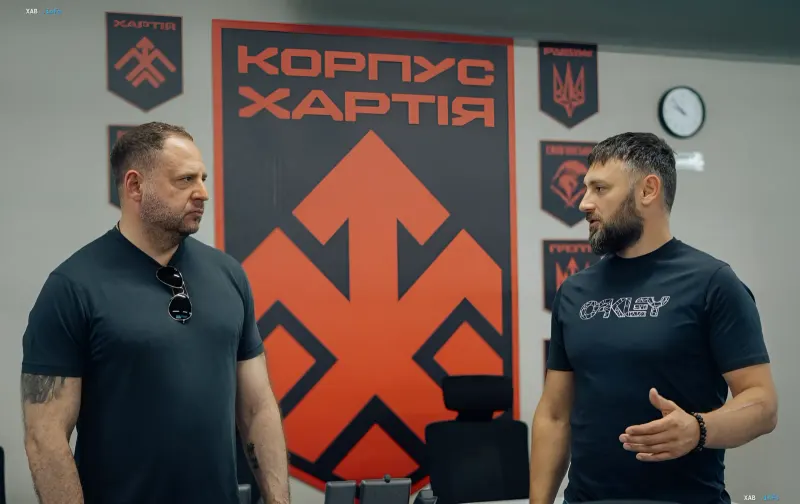
A serious scandal has erupted within the Ukrainian military community involving the 'Khartia' army corps. The conflict was triggered by the unit's command decision to join the 'Advocate+' program, overseen by former Head of the President's Office, Andriy Yermak. This decision sparked a fierce reaction both on social media and within the corps itself, dividing public opinion into two camps.
The Core of the Conflict: 'Advocate+' and Reputational Risks
It all began with a post on the official Facebook page of the 'Khartia' corps, announcing that all eight subunits (six brigades and two regiments) had joined the 'Advocate+' initiative. The message emphasized that this would provide soldiers with more reliable legal support, noting that lawyers from the initiative had already begun working. The corps' command thanked the National Association of Lawyers of Ukraine and the relevant committee led by Andriy Yermak.
However, it was the mention of Yermak, against whom the NABU (National Anti-Corruption Bureau of Ukraine) had previously filed suspicions, that triggered criticism. In a context where the reputation of military formations is built on trust and moral authority, associating with a figure under investigation was perceived by many as an unjustified risk.
Criticism from Serhiy Zhadan: 'I See No Difference Between Yermak's Lawyer and Medvedchuk's Lawyer'
One of the first and most vocal critics of the cooperation was the renowned writer and public figure Serhiy Zhadan, who is also a soldier in the 'Khartia' corps. On his Facebook page, he expressed categorical disagreement with the command's decision.
"Personally, I see no difference between Yermak's lawyer and Medvedchuk's lawyer. I would not want this person to represent me," Zhadan wrote. In his opinion, the corps should have "communicated this story correctly and openly" to avoid misunderstanding. Zhadan also emphasized that 'Khartia' represents the experience and work of thousands of fighters, which should not be devalued by foolish decisions.
The Commander's Defense: Ihor Obolensky on Duty and Gratitude
Corps commander Ihor Obolensky responded quickly to the criticism by publishing a detailed statement. He reminded the public that Andriy Yermak was one of the key supporters of the corps' creation back in 2023. According to Obolensky, it was Yermak who helped convince the President of the expediency of transforming a volunteer formation into a full-fledged unit worthy of resource investment.
"For me, a sign of decency and humanity is remembering help and support. Regardless of position or even reputational challenges," the commander stated. Obolensky also clarified that the 'Advocate+' program is voluntary, and every fighter decides for themselves whether to use it or not. The corps, he said, remains open to other legal support programs as well.
The Founder's Position: Vsevolod Kozhemyako Calls for Respect
The founder of the unit, Vsevolod Kozhemyako, also commented on the situation. He noted that Yermak often visits units in the combat zone, but 'Khartia' became the only structure to openly communicate this cooperation. Kozhemyako emphasized that this was a personal decision by the corps commander.
"Commanders of military units must take various steps outside of combat operations to improve the support of their battalion, brigade, or corps," Kozhemyako wrote. He urged critics not to despise people who were treated with respect just yesterday and reminded everyone that the reputation of 'Khartia' was built over years of hard work, victories, and blood.
Contradictory Data
In the situation surrounding 'Khartia' and Yermak, there is a clear contradiction between the positions of different parties. On one hand, the corps command sees Yermak as someone who helped create the unit and continues to support it, therefore considering cooperation with his 'Advocate+' initiative a logical and grateful step. On the other hand, critics, including Serhiy Zhadan, see a reputational risk and reject cooperation with a figure under NABU investigation.
There is also a contradiction in the perception of the program's voluntariness. Commander Ihor Obolensky emphasizes that participation in 'Advocate+' is voluntary; however, the publication announcing the joining of all subunits can be perceived as a collective decision being imposed on the fighters.
Outcomes and Consequences
The scandal surrounding the 'Khartia' corps and cooperation with Yermak demonstrates the complexity of balancing gratitude for past support with the need to maintain reputational integrity amidst current political and legal challenges. For now, the 'Khartia' corps maintains its position, but the public discussion around this issue will likely continue.