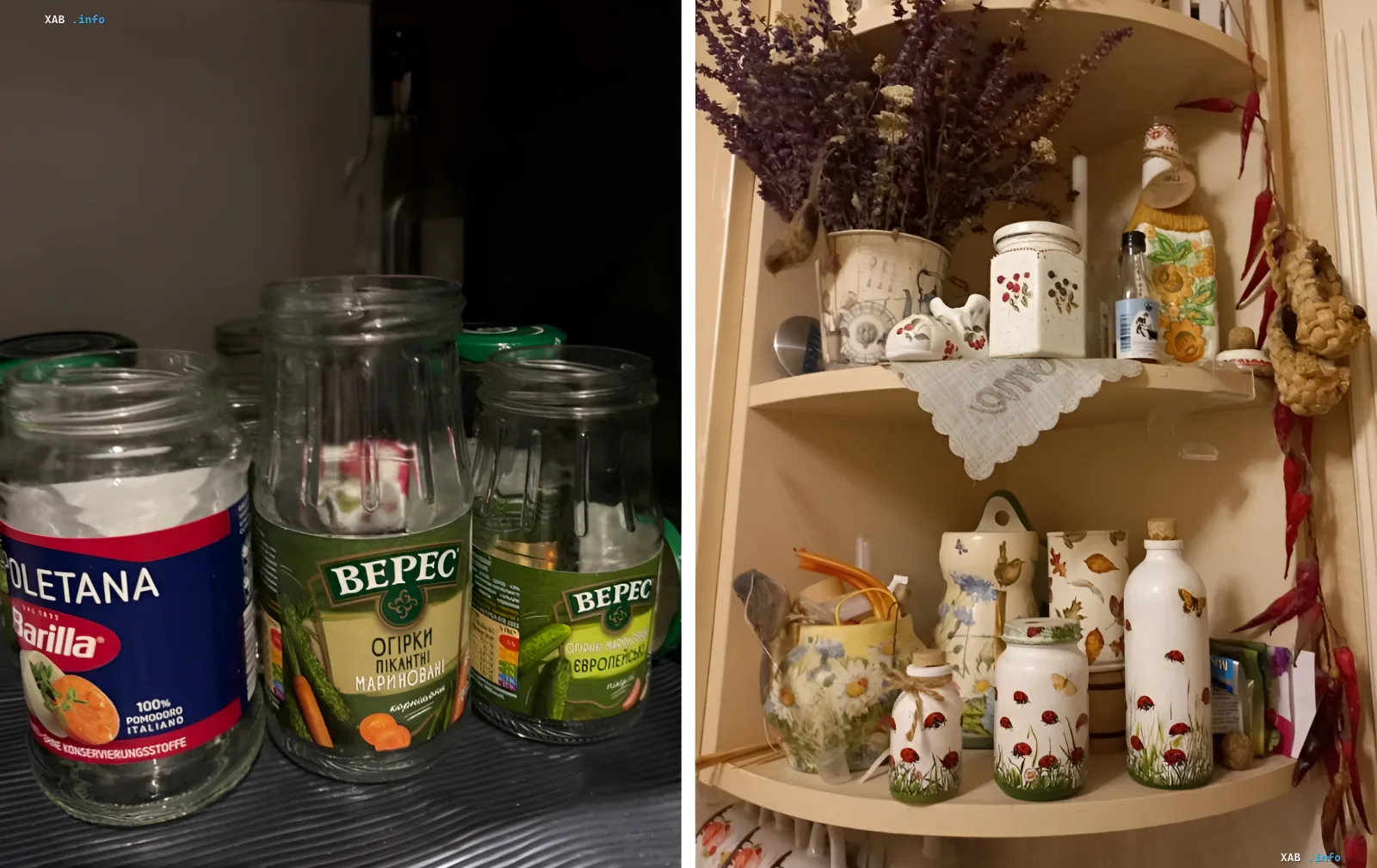
In the kitchens of most Ukrainian families, small glass jars from ketchup, adjika, pickled cucumbers, and other products regularly pile up. It's a shame to throw them away, yet they take up space on the shelf. That's exactly why the Styler project (RBC-Ukraine) turned to users on the social network Threads to find out how people give these containers a second life. The collection of answers turned out to be far broader than one might expect: from practical spice containers to elements of home decor.
Compact containers for everyday little things
One of the participants in the discussion, user a.kainova, shared that she long ago stopped throwing away the small jars left over from sauces and homemade preserves. In her words, in the kitchen they proved to be "far more useful than they first appear": they don't take up much space, they come with lids, and they're perfect for small stockpiles. She puts nuts in one container, raisins or seeds in another, and transfers spices or small items into a third — the kind of things that usually get lost among kitchen odds and ends. "You don't always need a whole jar of a product — sometimes it's more convenient to have a small portion on hand," the housewife notes. The key advantage, in her view, is that such jars can be used again and again: they don't gather dust in the cabinet but are genuinely useful in daily life.
Ready-made containers for homemade preserves
For many, small glass jars are virtually a ready-made vessel for canning. Threads users widely shared that they use them to seal up jam, jellies, adjika, homemade sauces, ketchup, and even caviar. "I dry plums and seal up sauces," one participant shared. Another wrote: "Ketchup, jam, preserves — I never have enough of these little jars." A separate set of ideas is tied to storing small portions: when you don't feel like opening a large jar of jam, a small container is far more convenient. Such jars are also handy for keeping homemade sauces and dressings in the fridge when you've only made a little. One participant described a funny family cycle: "I give them to my mom, and she sends them back with preserves in them."
From "nutella" to superfoods for the military
The range of uses isn't limited to food. One user admitted that she keeps ingredients for homemade "nutella" in the small jars and uses them when she needs to pass a portion of homemade food or preserves to relatives. Another, larger-scale scenario was described by those who deliberately buy up such containers to seal in honey with nuts and other "superfoods" for the military. There's also a creative approach: some users paint the jars and turn them into an original decorative element — in the photos attached to the discussion, you can see ceramic and glass containers with ladybugs, butterflies, and wildflowers painted on them, arranged on corner shelves next to dried flowers.
Contradictory views
Despite the abundance of creative ideas, the discussion also featured a directly opposing position. "I throw them away — I don't need to start collecting jars, I have no space to begin with," one participant candidly admitted. Thus, there is no single universal rule: for some, small glass containers are an invaluable household tool, while for others they're just extra clutter that only crowds the space. The decision whether to keep a jar or send it to recycling is left to each user and depends on the size of the kitchen, the amount of preserves, and personal habits.
Practical takeaway
Gathering all the options from the discussion, several consistent scenarios for reusing small glass jars stand out: storing nuts, seeds, spices, and cheese toppings; canning jam, jellies, sauces, and adjika in small portions; packaging homemade preserves to pass to relatives; preparing food kits (honey with nuts and similar items); and decorative kitchen styling after painting. If a container doesn't fit into your routine, you can dispose of it without guilt — the main thing is that the glass goes into the appropriate recycling bin, not the regular trash can.