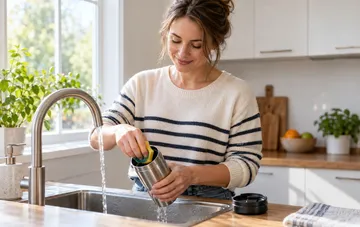
Burnt-on food residue on a stainless steel pan is one of the most common problems in any home kitchen. A regular sponge and dish soap are often powerless against stubborn, long-standing grime, while aggressive abrasives can damage the surface. Journalist Ashley Poskin decided to investigate the issue experimentally: she tested five popular home-cleaning methods on the same pan with identical soiling. The results of the test, published by The Kitchn and summarized by the Styler project (RBC-Ukraine), showed that the difference between the fastest and the slowest method is more than twentyfold.
Experiment Methodology: Identical Conditions for All Five Options
For the test, a single stainless steel pan was used. On its very hot surface, an egg was deliberately cooked so that it stuck firmly and formed a characteristic dark deposit. The pan was then allowed to cool completely to room temperature. Each of the five methods was tested on this same surface, which eliminated the influence of differences in material or degree of soiling. This approach made it possible to obtain comparable data on cleaning time and effectiveness.
The Test Winner: Baking Soda and Aluminum Foil
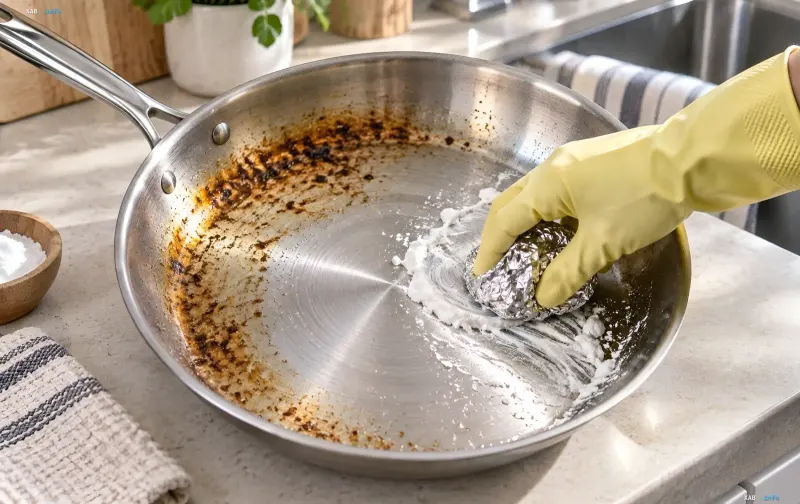
The simplest and, as it turned out, the most effective method is the combination of baking soda and aluminum foil. About two to three tablespoons of baking soda are sprinkled onto the soiled surface, a little water is added, and the mixture is stirred into a thick paste. Then a piece of aluminum foil is crumpled into a tight ball and used to rub away the burnt residue. There is no need to press hard — it is enough to go over the problem areas a few times. After cleaning, the pan is thoroughly rinsed with warm water and dish soap. According to the test results, the main deposit was removed in about three minutes, making this method the undisputed leader among the five options tested.
Lemon and a Dishwasher Tablet: Reliable "Silver Medalists"
Second place went to the lemon method. The fruit is cut into quarters, placed in the pan, and covered with water so that it submerges the soiled areas. The mixture is brought to a boil and left for five to ten minutes. As it heats up, the burnt residue gradually loosens from the surface. The water and lemons are then poured out, and the pan is washed with a sponge or brush. The method is fairly effective, but it takes about twenty-five minutes from start to finish. Third place went to a dishwasher tablet: a small amount of water is poured into the pan, warmed slightly, removed from the heat, and the soiled spots are rubbed with the tablet. The burnt deposit comes off quite quickly, and the whole procedure takes three to five minutes. In terms of the cleanliness of the result, this option fell short of the soda-and-foil and lemon methods, but in terms of speed it is quite comparable to the leader.
The Popular "Grandma's" Recipe and a Dryer Sheet: Why They Lose
The fourth method — the classic combination of water, vinegar, and baking soda — turned out to be less impressive than its popularity online would suggest. A cup each of water and vinegar is poured into the pan and brought to a boil, then about two tablespoons of baking soda are added. After the chemical reaction, the residue still has to be scrubbed by hand with a sponge for a long time. The whole procedure took about twenty-five minutes, and the result was inferior to the previous three options. Fifth and last place went to a dryer sheet, a staple in English-speaking countries. Hot water is poured into the pan, a little detergent is added, and the sheet is placed in. The mixture is left for about an hour, after which the pan is washed with a sponge. Even after such a long soak, some of the burnt residue remained on the surface, and the total duration of the procedure was sixty-five to seventy minutes.
An Important Limitation: Not for All Coatings
The key caveat, which the authors of the test emphasize, is that all five methods were tested exclusively on stainless steel cookware. For pans with a non-stick, ceramic, or other special coating, abrasive cleaning — including with foil and soda — may be strictly prohibited by the manufacturer. Before using any home method, you must consult the instructions for your specific cookware model so as not to damage the protective layer or shorten its service life.