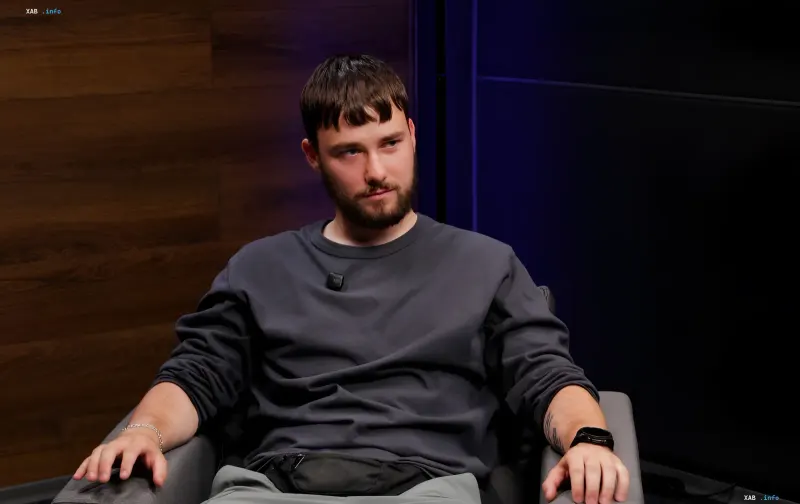
In August 2026, years after the start of the full-scale invasion, the perspective on the war that formed in the first months of 2022 underwent radical changes. Seraphim Gordienko, a member of the Armed Forces of Ukraine (AFU), founder of the cultural project 'Meta-Romanticism' and a member of the military motorcycle club MEMORIA, described this path of transformation in his interview with RBC-Ukraine. For him, as for many of his peers, the war began not with a draft, but with a conscious choice dictated by upbringing and the desire to become part of history.
'Heroic upbringing' and the path at 19
Gordienko's decision to go to the front at the age of 19 was dictated not so much by a sense of duty in the traditional sense, but by the environment and 'heroic upbringing'. He grew up on the aesthetics of the 19th century, the Napoleonic era, and literary epics, while the Revolution of Dignity became his first encounter with the reality of struggle. 'When all the heroes of your childhood are people who are somehow connected with struggle, it is natural to become that hero, at least for yourself,' he explains.
On February 24, 2022, while studying in Lviv, Gordienko decided to go to fight immediately. He took the first train to Kyiv and informed his parents of his intention without asking for permission, so as not to put them in a difficult moral position. His father replied only: 'I understood that. I wish you luck.' This decision was dictated by the maximalism and sincerity characteristic of that time, when young volunteers literally feared 'missing out' on the war, competing to see who would get into the fight first.
Personal order from the Commander-in-Chief: overcoming bureaucracy
The first six months of the war, Gordienko spent as a volunteer, performing infantry tasks and working on mortars. Later, he and a group of his comrades, who were also under the age of majority, decided to specialize in drones. However, when trying to officially register for service in the AFU, they encountered a legal barrier: everyone was under 21, which prevented them from signing a contract.
The situation was resolved thanks to their persistence and combat experience. According to Gordienko, they were only accepted into the army after a personal order was issued by the then Commander-in-Chief Valerii Zaluzhnyi. 'The entire Territorial Recruitment Center was paralyzed for a day: what kind of guys are these who want to get into the army so badly?' he recalls. This case became a vivid example of how, at the beginning of the war, enthusiasm and necessity could overcome rigid administrative directives.
The end of romance: from emotions to the 'war of machines'
Gordienko notes that the turning point in the perception of the war occurred after the Zaporizhzhia counteroffensive in 2023. If in 2022 emotions and the desire for a speedy victory dominated, then after 2023 the war became colder, more rational, and systematic. 'Romanticism ended in 2023... The war of military machines began,' he states. In his opinion, methods of destruction and defense went through an imbalance and began to adapt to each other, turning the conflict into a complex engineering and logistical task.
Infantry and drone synergy
An important aspect of modern war, according to Gordienko, is the inseparable link between infantry and drones. He emphasizes that drones cannot work effectively without infantry, and vice versa. In the conditions of the 'war of machines', the human factor remains critical, but its role has transformed: now it is not just a soldier with a weapon, but an operator of complex systems making decisions based on data. This transition from 'romance' to systematization determined the nature of hostilities for years to come.