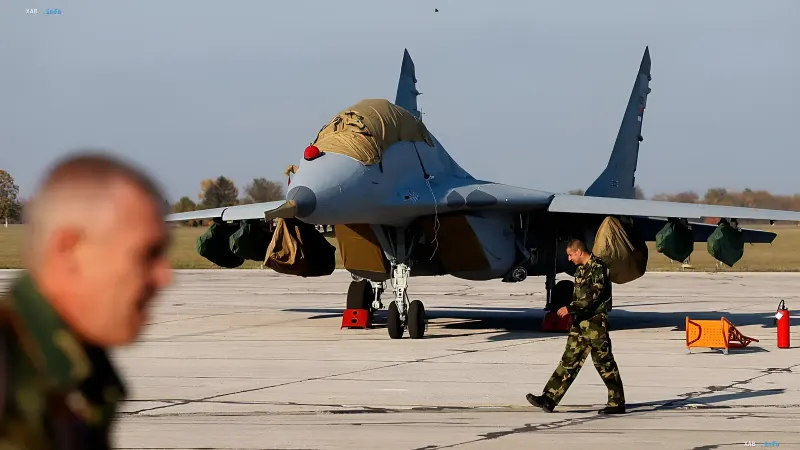
On Tuesday morning, November 17, 2026, a MiG-29 fighter jet of the Serbian Air Force crashed. According to the Ministry of Defense, the incident occurred at approximately 08:45 local time in the Stara Pazova area, northwest of Belgrade, about 35 kilometers from the capital. The aircraft fell on a field between the settlements of Nova Pazova and Stara Pazova. The only person on board, the pilot, died. Medical teams, firefighters, the police, and the military police arrived at the crash site, and the competent prosecutor was notified.
Training flight without ammunition
According to the Serbian military, at the time of the incident, the fighter jet was performing a training mission, so there was no ammunition on board. It is reported that the aircraft belonged to the 204th Aviation Brigade based at Batajnica Airfield. Preliminary causes of the crash have not been named at the time of publication; the department emphasizes that it was a routine training flight, which excludes the combat payload factor as a possible cause of the accident.
Pilot: Major Goran Bulajic
The pilot was Major Goran Bulajic, 53. According to the Ministry of Defense, he had served in the Serbian Army since 1996, spanning about three decades. The deceased leaves behind two children. The Minister of Defense and the Air Force Commander sent their condolences to the family. The pilot's identity and experience were confirmed by several Serbian and international publications citing the department's statement.
Investigation: two commissions
The Ministry of Defense statement says that a commission has been set up to investigate the incident, tasked with determining the circumstances and whether there was any responsibility on the part of the military organization. Simultaneously, an Air Force expert commission has been appointed to determine the technical cause of the plane crash. Thus, the investigation is being conducted along two lines — organizational-legal and technical.
About the aircraft: MiG-29 after four decades of service
The MiG-29 fighter was developed by the Mikoyan-Gurevich design bureau in the USSR in the early 1970s and entered service with the Soviet Air Force in 1983. According to the U.S. National Museum of the United States Air Force, the aircraft is equipped with a 30mm cannon and can carry six air-to-air missiles, as well as bombs and rockets. Despite the age of the platform, MiG-29s remain in service with several air forces, including Serbia, where they continue to be used, including for training flights.
Context
The crash in Serbia comes against the background of MiG-29s still remaining in several air fleets. For comparison: on the night of June 27, 2026, the Ukrainian Air Force lost a fighter of the same type during a combat mission in the Poltava region; the pilot ejected and made contact with the search and rescue team. These episodes underscore that the platform, developed nearly half a century ago, continues to be actively operated, and issues of safety and the technical condition of the fleet remain relevant for operator countries.