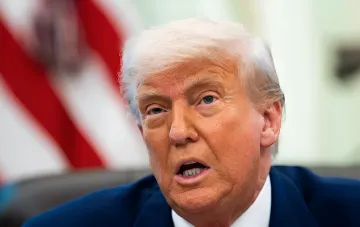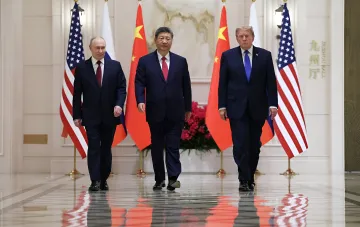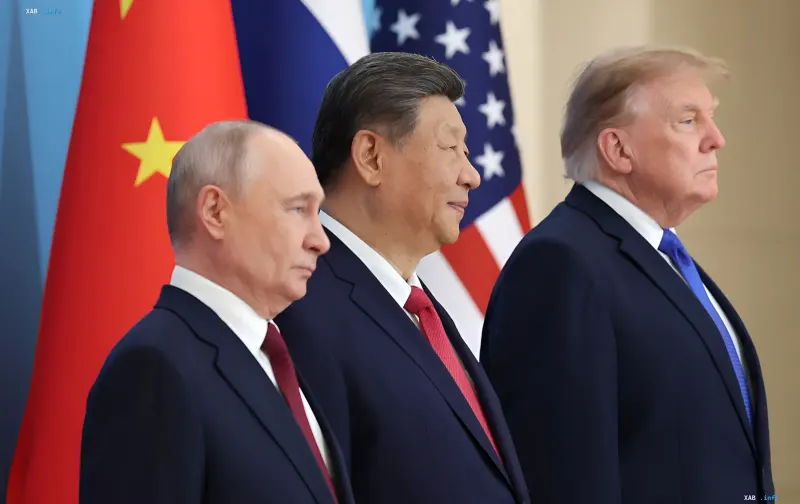
On November 19, 2026, the first-ever trilateral summit of the leaders of the US, China, and Russia concluded in Shenzhen, China. Donald Trump, Xi Jinping, and Vladimir Putin held talks lasting about an hour and a half, following which the three parties published a joint "Peace Declaration." The meeting took place against the backdrop of ongoing hostilities in Ukraine and "tectonic shifts" in the global security architecture mentioned by the Chinese leader.
Protocol Statements and Closed-Door Talks
Before moving to the closed-door portion of the summit, each of the leaders delivered brief protocol statements to journalists: Xi Jinping spoke for three minutes, Vladimir Putin for two and a half, and Donald Trump for four and a half. The Chinese leader mentioned the joint struggle of the three states in World War II, declared the need for a total ban and elimination of nuclear weapons, and urged major powers to set a "worthy example of interaction" amid global transformations. At the conclusion of contacts, he assessed them as "positive and constructive." Putin emphasized the status of the victorious powers in World War II and shared responsibility for international security, energy and food links, and the fight against terrorism. He called the war against Ukraine a "regional conflict," noting that he paid attention to it at the preceding 35-minute bilateral meeting with Trump. Trump stated that the three largest nuclear powers must reduce nuclear risks and prevent Iran from acquiring nuclear weapons. Regarding the war in Ukraine, he expressed the view that both sides strive to end it. Trump also criticized the International Criminal Court, calling it a "rogue globalist organization out of control."
"Peace Declaration" Without Mentioning Ukraine
Following the negotiations, Beijing, Washington, and Moscow published a joint "Peace Declaration." The document does not contain a single mention of Russia's war against Ukraine or European security. The parties recorded four general points concerning global challenges. Kremlin spokesman Dmitry Peskov subsequently confirmed that the Ukraine topic was not the main one at the trilateral summit. After the closed-door talks, Trump and Putin left the venue, and Putin held a separate press conference following the meeting.
Putin's Press Conference: Narratives and Reaction to Crimean Bridge Strikes
At a separate press conference, Vladimir Putin once again outlined the Kremlin's positions on the conflict in Ukraine, shifting the responsibility for escalation to Kyiv and the West. He stated that Russia "did not undertake any war at all," and the hostilities in eastern Ukraine, according to him, were unleashed by the "Kyiv regime." He justified the full-scale invasion as an attempt to "finish what started eight years ago," during which, he claimed, Moscow "sought a peaceful settlement." Putin also stated that he agreed to US compromise proposals on Ukraine during his meeting with Trump in Anchorage, and accused Kyiv and Europe of unwillingness to make similar concessions. Separately, he publicly reacted for the first time to Ukrainian strikes on the Crimean Bridge on the nights of November 16, 17, and 19, which, according to him, damaged one of the crossing's arches, a span of the road bridge, and the railway section. Putin stated that the bridge "is an exclusively peaceful object" and has long not been used for transporting military equipment and petroleum products. He reported that he discussed with the Russian Security Council a possible ceasefire in a number of areas, but after the attacks on the bridge, he said, Russia will not negotiate, and threatened that the response will be "much more painful."
Expert Assessment: Protocol Demonstration and "Most Expensive Photoshoot"
Political analyst Oleh Sakian, in a comment to RBC-Ukraine, noted that Moscow's attempt to create the illusion of a new "Yalta" — a reference to the 1945 conference that determined the post-war order of Europe — failed. In his assessment, the meeting became rather a protocol demonstration in which each participant pursued their own image goals: Trump to neutralize negativity after the US election, Xi Jinping to demonstrate China's global weight. Sakian emphasized that in an hour and a half, taking into account translation into three languages, it was physically impossible to hold substantive negotiations, which is why for Russia the meeting turned into, in his expression, "the most expensive photoshoot in history." The expert also pointed out that Beijing, through diplomatic gestures, demonstrated that it does not consider Putin an equal to Trump and Xi Jinping. In his opinion, the summit will in no way affect the course of the war in Ukraine, as the interests of the three countries differ significantly, and in the modern world there are other powerful players — India, Turkey, Arab states — whose role was not represented at the venue.