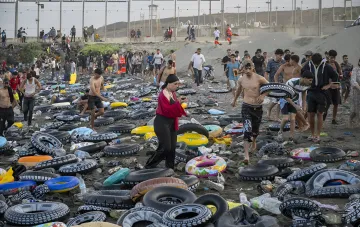
The Spanish autonomous city of Ceuta in northern Africa is facing an unprecedented crisis. In the night from July 29 to 30, tens of thousands of people breached the border with Morocco. According to estimates by Juan Jesús Vivás, the head of the Ceuta government, the total number of migrants reached 60,000 — more than half the population of the city itself, which stands at around 84,000.
Judicial Trigger and Social Explosion
The immediate trigger for the mass assault was a ruling by the Supreme Court of Spain. The court prohibited local authorities from immediately turning back migrants intercepted at sea while attempting to reach Ceuta or Melilla. News of this ruling instantly spread across social media, becoming a signal to action for many Moroccans.
Railway stations in Rabat and Casablanca were overwhelmed with people desperate to head north. Young Moroccans explain their choice by the lack of prospects at home. According to official data, a quarter of Moroccans aged 15 to 24 are not in education, employment, or training (NEET). Last year, protests already erupted in the country over the unequal distribution of wealth and demands for reforms in healthcare and education.
"There is Nothing at Home": Stories of Those Who Took the Risk
21-year-old Abdallah Boudji, a student at a pedagogical college, told the AP agency about his decision. He was studying to be a teacher but understood that at home, he would only face 12-hour shifts for a meager salary. Hearing about the border breach, he got on a motorcycle and raced toward Ceuta. The journey proved dangerous: he lost his belongings and money and nearly died along the way. Realizing he would likely face arrest, he turned back and headed home.
A similar story was told by Brahim, a bakery worker from Fes. After watching videos of migrants on social media, he left his job and came to Ceuta hoping to build a better future. However, reality proved harsh. Brahim spent three days surviving on water alone, as he could not afford food due to high prices. "Why was a tuna sandwich sold for 100 dirhams?" he wondered. Returning migrants also complained about closed shops and attacks by locals who drove them off the streets.
Tragedy at the Border and Europe's Reaction
The large-scale operation was accompanied by clashes and car burnings. All refugee reception centers in the Spanish city were overcrowded, forcing many people to sleep on the streets amidst frightened locals and armed police. According to Reuters, the bodies of 57 migrants were found on the Spanish side of the border: some drowned, while others died trying to climb over the breakwater holding the border fence.
The situation caused a stir in the European Union. Italian Foreign Minister Antonio Tajani called for closing the Schengen zone to Spain. On July 31, France announced the strengthening of security measures on its border with Spain.
Return to Calm
By August 1, the situation began to stabilize. Spanish Foreign Minister José Manuel Albares reported that almost all migrants who illegally entered Ceuta had already returned to Morocco. Of the 60,000 people who crossed the border, approximately 45,000 returned home. The city is gradually returning to normal life: cafes have reopened, although most shops remain closed, and streets continue to be patrolled by reinforced police units.