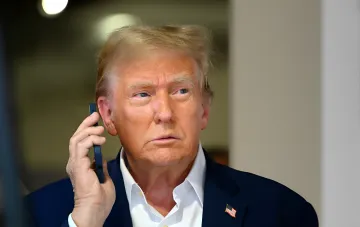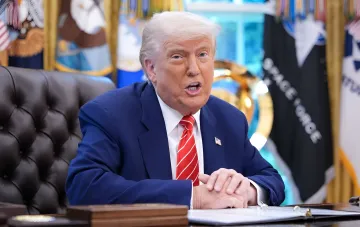
On Thursday, October 16, 2026, the Super Intelligence Force (SIF) interagency group—created by U.S. President Donald Trump at the beginning of the current month—held its inaugural meeting. Meeting participants agreed on priority areas of work: risk assessment in cybersecurity and biosafety, as well as issues of "model control and accountability." This was reported by the White House, with details disclosed by the newspaper Kommersant.
A shift in rhetoric: from anti-regulation to oversight
The formation of SIF marks a noticeable shift in the position of the White House chief, who until recently consistently opposed the strengthening of state regulation of artificial intelligence. This week at a rally in Arizona, Trump publicly acknowledged that a certain level of control is necessary for AI development. "We call AI superintelligence... But in certain cases, it may happen that this superintelligence becomes 'too super,' and we need to keep an eye on such cases," he told voters, according to Kommersant. Thus, the president's rhetoric shifted from a total denial of regulatory intervention to the recognition of specific scenarios requiring supervision.
Structure and authority of the group
Leadership of SIF has been entrusted to U.S. Director of National Intelligence Jay Clayton. According to the White House statement, the group is required to submit a task assignment to the President's Council of Science and Technology to prepare an analytical report on identified and related problems. SIF's tasks also include "developing protocols and mechanisms through which laboratories can provide the government with early warnings and systematic notifications of security breaches." In addition, the White House announced plans to establish a law enforcement and consumer protection coordination committee, which will include representatives from the Department of Justice, the Federal Trade Commission, and several other agencies.
Public context: elections, data centers, and public concerns
The topic of artificial intelligence has become acutely relevant in the U.S. ahead of the midterm elections. According to Bloomberg, public dissatisfaction is growing over the large-scale construction of data centers, which is linked to a sharp increase in electricity costs. Public fears regarding potential mass job losses and catastrophic consequences if humanity loses control of AI are sounding much louder than statements about the potential benefits of the technology. This background likely prompted the administration to take demonstrative steps to "supervise" superintelligence.
Industry memorandum: an alternative to direct state regulation
Despite the creation of SIF, Trump refused to follow direct calls for increased state regulation of the AI sector, arguing that strict norms would hinder U.S. competitiveness in confrontation with China. Instead, at the end of September at the White House, mediated by the president, a memorandum was signed with the participation of top executives from leading tech companies. The document obliges AI industry representatives to hold regular meetings to develop advanced industry standards, as well as to create independent committees within their structures to oversee AI development. A key element of the agreement was the involvement of third-party auditors to assess AI system safety.
International resonance
Trump's initiative is already finding resonance outside the United States. As inform.kz reports, President of Kazakhstan Kassym-Jomart Tokayev expressed support for the superintelligence security agreement initiated by the American leader. Kazakh experts point out that the memorandum signed in the White House could become the basis for forming international rules in the field of AI, giving the initiative a cross-border character.