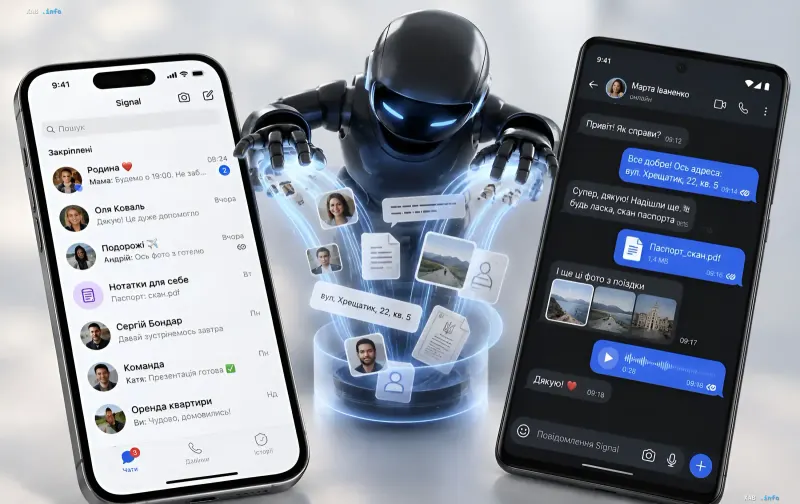
The Signal messenger has introduced restrictions on taking screenshots in its apps for iOS 27 and a number of Android versions to prevent the interception of confidential chats by AI agents built into operating systems. The company announced this in its official blog, as reported by RBC-Ukraine. In essence, Signal is trying for the first time at the application level to close the "digital window" through which Siri AI with the Onscreen Awareness feature and Google Gemini Intelligence gain access to the device screen's contents — and consequently to users' personal messages.
Why the Messenger is Acting Right Now
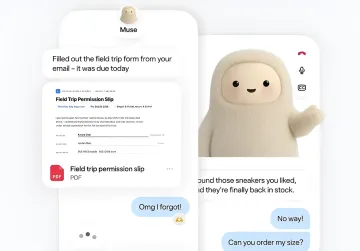
The reason for Signal's move is the systemic integration of artificial intelligence agent capabilities directly into operating systems. Google, Apple, and Microsoft are embedding AI assistants into the core of their platforms: Gemini Intelligence works alongside Google Gemini, while Siri AI has received the Onscreen Awareness module, which analyzes everything displayed on the screen to answer user requests and perform tasks. For a messenger focused on end-to-end encryption, this means that even encrypted messages can be "read" not by hacking the protocol, but through simple pixel analysis on the display. In such a scenario, confidential information from Signal ends up in a local database or on a remote server used by the AI agent, after which the messenger loses the ability to guarantee the protection of intercepted data. The confidentiality of the correspondence is compromised for all chat participants, not just the sender.
What Exactly is Restricted and How It Works
On iOS 27, Signal is introducing a restriction on taking screenshots directly within the application. On Android versions where an AI assistant's attempt to read the screen content is detected, blocking is activated. Users retain the option to disable this protection in the app settings, but Signal explicitly warns that removing restrictions will expose chat contents to AI agents and violate privacy guarantees for both the user and their contacts. The mechanism resembles the approach the messenger applied last year regarding the Recall feature in Windows 11, when screenshot blocking was enabled by default.
What the Protection Does Not Cover
Signal honestly acknowledges that the measures taken do not completely eliminate the problem. The ban on screenshots does not block other channels of obtaining information, including AI agents' access to files stored on the device. Furthermore, operating system manufacturers do not yet provide app developers with simple and standardized tools to restrict AI access to data without degrading overall app performance. For this exact reason, Signal cannot currently introduce similar protection on macOS, where the architecture of screen and file system access is structured differently. The situation is further complicated by an acute shortage of technical documentation on how AI agents in iOS and Android actually receive and process screen data. In recent months, Signal developers have been forced to independently research both platforms to understand the mechanisms of AI access to messenger data.
Call to Manufacturers and the Issue of Industry Standards
Signal urges Apple, Google, and Microsoft to provide developers with clear APIs and technical specifications that will allow apps to consciously manage AI agents' access to their content. The company also emphasizes the need for protection not only against built-in assistants, but also against third-party AI agents, particularly Meta Muse. At the time of publication, Signal reports that it is already in negotiations with operating system manufacturers — primarily Google and Apple — and expects the formation of unified industry standards for privacy protection in an era when AI agents become a permanent "observer" on the screen of every device.
Broader Context: The Race Between Privacy and Agentic AI
Signal's move is not an isolated decision, but part of a growing conflict between two trends. On one hand, major tech companies are actively embedding agentic AI into operating systems, making it the user's "hands and eyes." On the other hand, messengers and applications whose business model is built on privacy are forced to build defense at the interface level because systemic defense mechanisms against them do not yet exist. If Apple, Google, and Microsoft fail to provide developers with adequate tools in the coming months, such "crutches" in the form of screenshot blocking will likely become a widespread phenomenon — and not just in Signal.