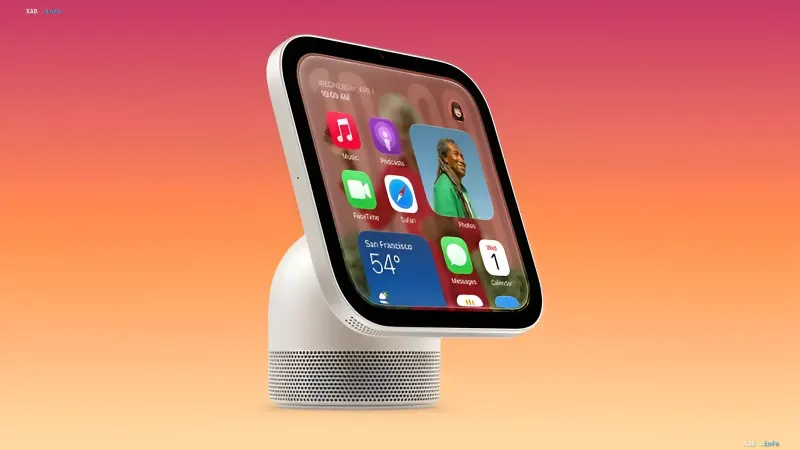
Apple has begun shipping its new home device, HomeView, which the company introduced exactly a month ago. First buyers in Australia and New Zealand are receiving their pre-ordered gadgets as early as November 13, 2026. Thus, the new product is officially entering the market, completing the announcement phase and moving into mass distribution. HomeView is positioned by Apple as the central element of the smart home ecosystem — a device designed to become the "face" and "voice" of the home space for the entire family.
Form Factor: Square Screen on an Acoustic Base
In terms of its concept, HomeView is a hybrid of a compact tablet and a HomePod smart speaker. The device features a 7-inch square touchscreen surrounded by a white housing with rounded corners, and a built-in camera for video calls and facial recognition. Apple offers two versions: a desktop version with an integrated acoustic base resembling a shortened HomePod in shape, and a wall-mount option. However, the wall mount must be purchased separately, which has already raised questions from some potential buyers who expected it to be included in the box.
Recognition of Up to Six People and Personalization
A key feature of HomeView is its multimodal voice and image recognition system, capable of identifying up to six family members. Depending on who is in front of the device, the screen displays personalized information: an individual's calendar, notifications, and music preferences. HomeView supports video calls, video viewing, a calendar, weather forecasts, music playback, and smart home device control. The new device does not have its own App Store — instead, it features pre-installed Apple apps and widgets synchronized with the owner's iPhone.
Software Foundation: Siri with Artificial Intelligence in iOS 27
The software foundation of HomeView is the new version of the Siri voice assistant, enhanced with artificial intelligence capabilities and introduced as part of iOS 27. It is this updated assistant that provides contextual understanding of queries, smart home device control, and personalized responses. The lack of a dedicated app store means the device's functionality is tied to the Apple ecosystem and cannot be expanded by third-party developers — which, according to analysts, is a deliberate company decision to maintain control over the user experience.
Price and Launch Geography
The price of HomeView is 300 US dollars. Sales started in Australia and New Zealand, which is typical for Apple, traditionally choosing Oceania markets for the first shipments of new devices. Deliveries are expected to expand to North America, Europe, and Asia in the coming weeks. The wall mount, as already noted, is sold separately, increasing the total cost of ownership for those choosing wall installation.
HomeView's Place in Apple's Strategy
The release of HomeView concludes Apple's multi-year series of attempts to establish a foothold in the home display device market. Previous iterations, including Apple TV and HomePod, lacked a full-fledged screen or were limited in functionality. HomeView, which combines a screen, camera, facial recognition, and an AI assistant, represents the company's most ambitious attempt to create a "family hub" in the living room. The success of the device will largely depend on how deeply AI-powered Siri is integrated into everyday scenarios — from lighting control to video calls with relatives.