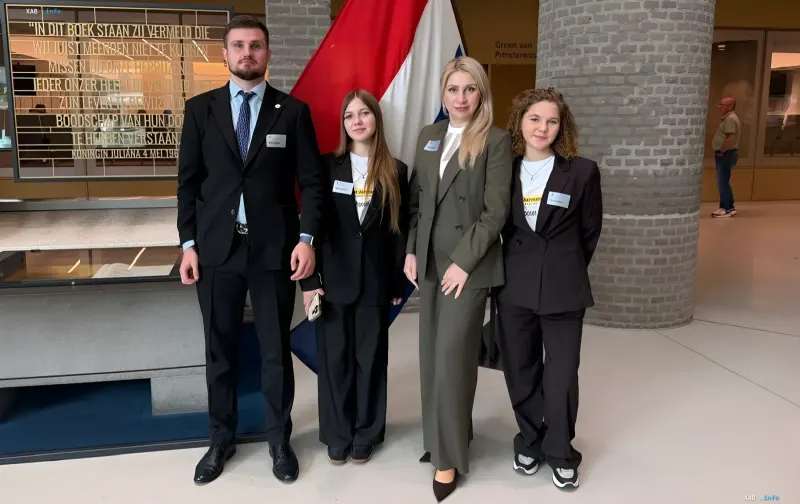
A delegation of the Rinat Akhmetov Foundation, comprising participants of the pilot project “Youth Chooses Ukraine” and a representative of the Office of the Ombudsman of Ukraine, carried out an international visit to the Netherlands that culminated in an address to the country’s parliament. The central figures of the visit were twin sisters Olga and Alina from Donetsk, who lived on the temporarily occupied territory for ten years while maintaining a pro-Ukrainian stance, and who ultimately moved to Kyiv on their own to continue their education. At the Dutch parliament, the young women spoke about the importance of systematic support for youth returning from occupation or after illegal displacement, and about the mechanisms for their adaptation in Ukraine.
Ten Years Under Pressure: Life in Occupied Donetsk
According to the sisters, life in occupied Donetsk was accompanied by constant pressure. Because of their Ukrainian accent, the girls received lower grades, were humiliated by their peers, and teachers filed complaints against them. Speaking Ukrainian openly was dangerous, yet Alina studied the language on her own and prepared to enter a Ukrainian university. In the end, the sisters decided to leave occupied Donetsk for Kyiv on their own to continue their studies in Ukraine. “I always understood that I wanted to get a profession, develop, and achieve results in life. But under occupation I saw no such future for myself. I did not want to enter a Russian university, because I understood that it would not give me the opportunity to realize my plans,” said 19-year-old Olga, adding that only after returning to Ukraine did she truly feel free.
The “Youth Chooses Ukraine” Project: From Isolation to Socialization
The sisters are participants in the pilot project “Youth Chooses Ukraine,” which is aimed at overcoming the consequences of isolation and accelerating the socialization of returned youth. Alina, who dreams of becoming an architect and, after victory, helping to rebuild her native Donetsk, noted that the project allows her to meet mentors who help her achieve her personal and professional goals. “It is very important to me that, thanks to this project, I can build my future and receive support. It hurts to see how the city has fallen into decay over the years of occupation. That is why I want to develop precisely in Ukraine,” the young woman emphasized. The Foundation’s CEO, Ksenia Sukhova, stated that, together with the state, the Foundation is developing a clear support route that in the future could become a protocol for youth returning from temporarily occupied territories or after illegal deportation.
The Hague as a Center of International Accountability
As part of the visit, the delegation also visited the Embassy of Ukraine in the Netherlands, where they discussed the needs of Ukrainian youth. Ksenia Sukhova handed commemorative bracelets to the embassy representatives as part of the project for systematic assistance to the defenders of Mariupol and their families, “Heart of Azovstal.” In her words, the Netherlands holds a special place in international work on Ukraine, since The Hague is home to the International Court of Justice and the International Criminal Court. Cooperation with these institutions, the Foundation’s head underlined, is critically important for ensuring Russia’s accountability for the crimes committed on Ukrainian territory.
FC Shakhtar and the Champions League: An International Showcase for the Project
A separate element of the Dutch visit was a meeting with FC Shakhtar, which is a partner of the “Youth Chooses Ukraine” project and helps present it on the international stage. Together with Ksenia Sukhova, Olga and Alina attended an open pre-match training session of the “miners” in Eindhoven — the sisters’ long-held dream of seeing their favorite team live was finally fulfilled. Ahead of them is the UEFA Champions League match in the first round, PSV vs. Shakhtar, which will be the first in which the team takes the field in a kit bearing the Rinat Akhmetov Foundation logo. During the Champions League matches, this logo will help introduce the international audience to the stories of the project’s participants.
A Signal to Those Remaining in the Occupied Territories
The key message of the visit, according to Ksenia Sukhova, was to form a clear signal for those who today remain in the occupied territories and are wondering whether to return to Ukraine. “It is important for us to convey that in Ukraine they are awaited, that there are opportunities here for education, work, development and life, and that the state and partners are ready to help them go through this path,” the Foundation’s CEO stated. The story of Olga and Alina, who maintained their Ukrainian identity for ten years under conditions of systematic pressure and ultimately crossed the line of contact on their own, became a vivid example that such a path is possible and is supported at the institutional level.