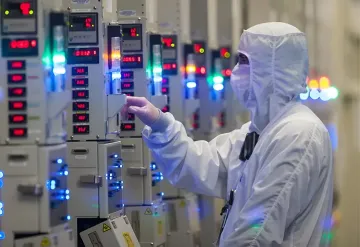

The idea of a fairer distribution of the windfall profits that participants in the artificial intelligence tech boom are earning beyond expectations has stopped being an abstract debate. In several countries it has already led to literal payments to the population, but in most cases shareholders still have to negotiate with corporate management for their slice of so-called "AI dividends." South Korean memory maker SK hynix has taken one of the most prominent steps in this direction: the company has pledged to increase the share of free cash flow distributed to investors and to direct roughly $29 billion toward buying back its own shares in the near term. All of this is happening against the backdrop of efforts to set a fair premium for employees working in memory production, although the new initiative is aimed primarily at external beneficiaries — the holders of its securities.
Record $29 Billion Buyback
As Bloomberg notes, SK hynix has committed to carrying out a share buyback worth $29 billion during the period from August 19 to 20, 2026, followed by their cancellation. The cancellation is key: it reduces the total number of shares outstanding and thereby increases each remaining shareholder's stake in the company's capital. For the memory market, which in recent months has become one of the main beneficiaries of the AI boom, such a move reads as a signal that management is ready to share the super-profits rather than hoard them on the balance sheet.
A Shift in Profit Distribution Policy
In addition to the one-off buyback, the company announced a deeper change: the share of free cash flow directed to shareholders and investors will be raised to a level above 50%. Previously this figure sat below the 50% mark. According to Etoro analysts, it is precisely this pledge that matters even more to investors than the large buyback itself: the latter is a one-time action and will quickly be forgotten, whereas the income redistribution norm will be locked in for a long time and will please shareholders noticeably longer. This effectively rewrites the contract between the company and the market for years to come.
Market Reaction and Analyst Assessment
The market reacted to the statements promptly: SK hynix's American depositary receipts managed to rise 7.1% in price before the start of the main US trading session. The context amplifies the effect — last month the company listed on a US exchange to raise $26.5 billion, and now it is again stoking interest in its own securities with corresponding commitments. At the same time, Allspring Global Investments experts warn that in the long term, the key interest rates of the monetary authorities of economically major countries will have a stronger influence on the share price dynamics of memory makers, while the buyback will provide only short-term support.
Contradictory Data
The available sources contain a discrepancy in the exact buyback amount. The main text and Finam data point to $29 billion, whereas the delo.ua publication cites a figure of $28.6 billion. The difference is immaterial to the overall picture and is likely explained by rounding or by a difference in the moment the exchange rate was fixed during conversion; however, for an accurate factual description both versions are recorded: $29 billion and $28.6 billion. The essence of the initiative — a record buyback with cancellation and a revision of the FCF return norm — is confirmed regardless of the specific amount.
Broader Context: Who Else Is Sharing AI Profits
SK hynix's initiative is not isolated. In parallel, other memory and semiconductor giants are also revising their payout policies: for example, Samsung, according to reports, is ready to split with shareholders the AI-boom windfall profit of roughly $72 billion. The combination of these steps is forming a new precedent: corporations whose revenue has soared on the wave of demand for memory and AI computing are beginning to systematically return part of the super-income to the holders of their securities. For investors this is a signal that "AI dividends" are moving from the realm of declarations into the realm of concrete financial obligations.