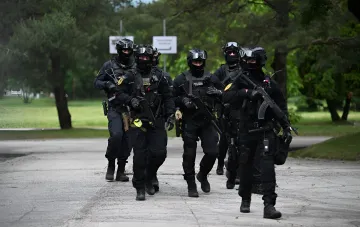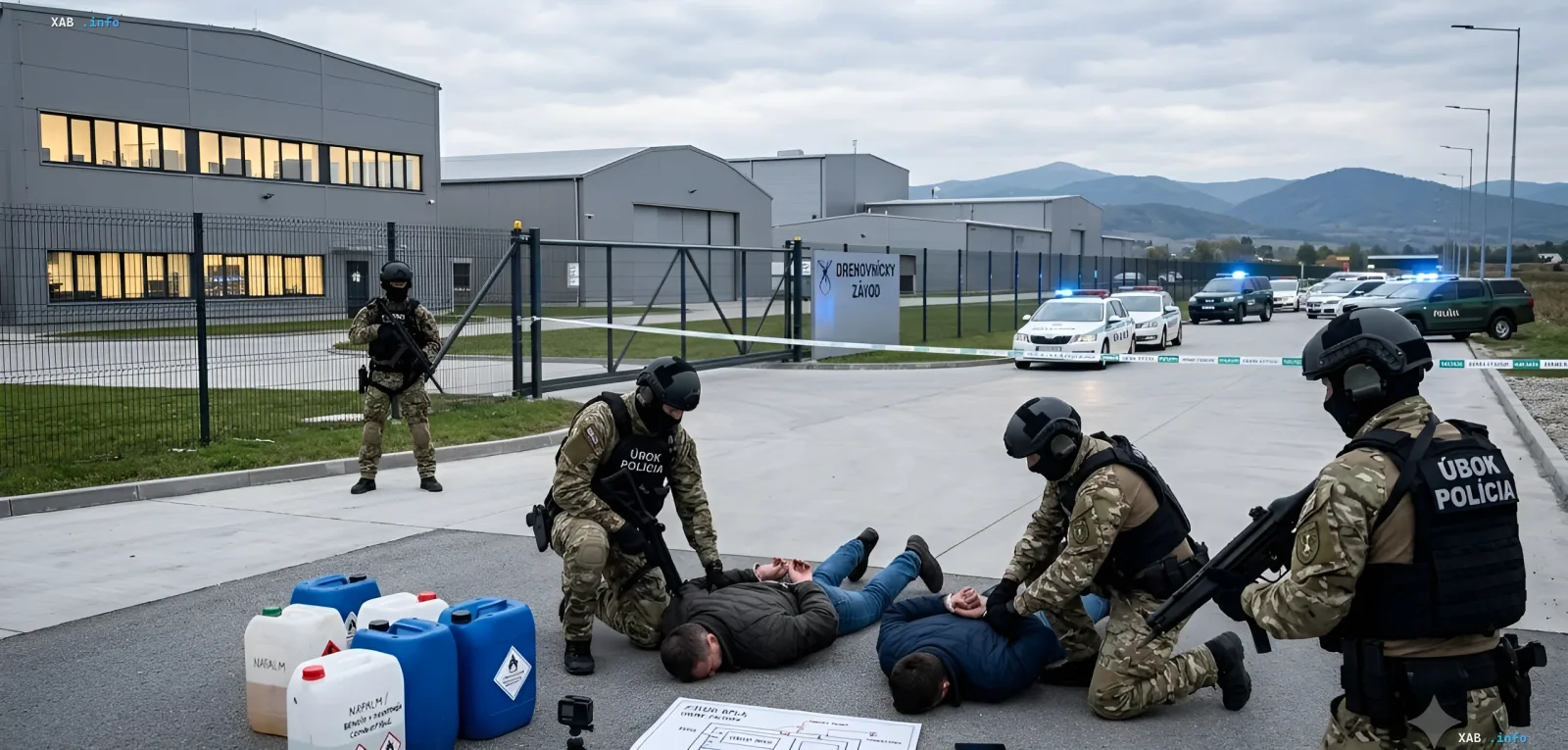
On Tuesday, 25 August 2026, Slovak law enforcement agencies announced the prevention of one of the largest sabotage operations against NATO military infrastructure in recent months. The Slovak Office for the Suppression of Organized Crime (ÚBOK), together with intelligence services, detained a clandestine group of three foreign nationals who were preparing to set fire to a strategic drone manufacturing plant in the eastern part of the country. According to official police press releases and reports from European agencies, including Reuters and Radio Svoboda, approximately 70 employees were inside the production workshop at the time of the planned attack — an arson attack using homemade napalm would have guaranteed a massive fire with mass casualties. The value of the equipment located in the workshop is estimated at tens of millions of euros.
What was seized from the saboteurs: an "infernal mixture" and a strike plan
Law enforcement acted in advance, intercepting the group before the moment of the actual strike. During emergency searches, a professional sabotage kit was seized from the suspects, indicating a high level of preparation. Forensic experts established that the seized incendiary mixture is a combination of gasoline and polystyrene — a classic homemade analogue of military napalm, capable of producing a sustained fire that cannot be extinguished with standard means. In addition to the "infernal mixture," the detained individuals were found to have a hand-drawn precise plan of the facility, an action camera for recording the results of the attack, and mobile phones with encrypted chats, through which, according to the investigation, the group's actions were coordinated. It was precisely the presence of a detailed plan and communication means that allowed investigators to classify the act as a group offense committed by prior conspiracy.
Hunt across two countries: how the group was caught
The commissioned nature of the crime forced the police to act swiftly and across borders. Two perpetrators were detained by special forces directly on Slovak territory. The third accomplice attempted to flee, but was intercepted by the German police on the basis of an urgently issued European Arrest Warrant. The names of the detained individuals, their nationality, as well as the specific name of the plant and its exact geolocation have been strictly classified by Slovak authorities in the interests of the investigation. It is known only that the enterprise is located in the eastern part of the country, in close proximity to the Ukrainian border. Investigators charged the foreigners with "creating a public danger, committed by a group of persons by prior commission" — a formulation that, in Slovak legal practice, indicates that the group acted not on personal initiative, but in carrying out an assignment from an external client.
Contradictory data
Open sources and statements from the parties show significant discrepancies in the interpretation of key details. First, in the headlines of several media outlets the event is presented as a "napalm attack," whereas forensic experts emphasize: the seized mixture is a homemade analogue of napalm, not a combat incendiary weapon of military grade. This difference is fundamental for understanding the level of preparation of the saboteurs. Second, the charge formulation "by prior commission" in a legal sense confirms only the presence of an external organizer, but does not name them. At the same time, analysts and some European publications interpret this formulation as direct evidence that the group was working for a foreign intelligence service. Slovak authorities, however, have neither publicly confirmed nor denied a link to a specific state. Third, in the context of the investigation, "coordination from a single center linked to the Russian Federation" is mentioned, however this version belongs to European intelligence services and is of the nature of a working hypothesis, not a fact confirmed by the investigation. Neither the Slovak prosecution nor Europol in their official statements of 25 August 2026 named the name or nationality of the client.
European context: a chain of sabotage operations against military infrastructure
The Slovak incident is not isolated. It fits into a growing chain of systematic attacks on defense facilities of NATO countries in Eastern Europe. In March 2026, a similar group, including a US citizen, was arrested in the Czech Republic for the arson of a drone warehouse of LPP Holding in Pardubice. In parallel, Germany is investigating incidents with booby-trapped drones at Leipzig airport, where Anton cargo planes from Ukraine were under threat. According to European intelligence services, in all three cases coordination from a single center can be traced. The totality of these episodes, according to analysts, indicates a transition of sabotage activity from pinpoint acts to a systematic campaign to paralyze military equipment supply chains in the region. The Slovak case, with its 70 potential victims and tens of millions of euros in damages, demonstrates that the scale and lethality of attacks are steadily growing.
What next: investigative secrecy and enhanced security
Slovak authorities intend to carry the investigation through to the establishment of all links in the chain — from the direct perpetrators to the ultimate client. The classification of data on the detained individuals and the target facility indicates that the investigation is not yet complete and there is a risk of a sabotage countermeasure. Eastern European countries, including Slovakia, the Czech Republic and Poland, have significantly strengthened the security regime for defense enterprises in recent months: additional posts have been introduced, factory perimeters have been equipped with early detection systems, and intelligence services have been granted expanded powers to monitor suspicious activity near strategic facilities. Nevertheless, as the events of 25 August show, even an enhanced regime does not guarantee complete protection — the group acted under complete cover and was detected only at the stage of direct preparation for the strike.