Poland's National Prosecutor's Office has presented the findings of an international group of experts regarding the causes of the April 10, 2010 air crash near Smolensk, which claimed the life of Polish President Lech Kaczyński. As prosecutor's office representative Przemysław Nowak stated at a press conference, according to the specialists' conclusions, neither an explosion nor a technical malfunction caused the disaster. In their view, the Tu-154M crashed due to a sequence of events that occurred during the approach to Smolensk-North Airport, including an incorrect assessment of the actual flight altitude.
How the Expert Report Was Prepared
The document was prepared by an international group comprising over 20 experts. According to Nowak, the group was formed back in 2019 under the Law and Justice party government. Specialists worked on the report for about five years, completing it in August 2024. Prosecutors translated the document into Polish, deemed it incomplete and unclear, and submitted 66 questions to the experts. In May of this year, the specialists provided an additional report, after translating which the prosecutor's office concluded that the entire body of expert materials was "complete and understandable."
What Specifically Was Investigated
According to the prosecutor's office, experts examined the preparation, organization, and execution of the flight, including the operations of the 36th Special Aviation Transport Regiment. They checked the crew's qualifications and actions, the technical condition of the aircraft, flight recorder data, weather conditions, and the preparation of Smolensk-North Airfield. The circumstances of the crash, aircraft damage, victim injuries, and the results of physicochemical analyses—including the question of whether an explosion could have occurred—were studied separately. "The experts have established the cause of this disaster," Nowak stated, emphasizing that no signs of an attack or sabotage were found.
Chronology of the Final Minutes of Flight
The landing was performed under difficult weather conditions: dense fog hung over the airport, the runway was impossible to see, and the aircraft was descending too fast, dropping below the minimum permissible altitude despite conditions being unsafe for landing. In the final stage, the Ground Proximity Warning System (TAWS) repeatedly signaled the risk of ground contact. At 10:40:51 local Smolensk time (8:40:51 Polish time), the commander decided to abort the approach and execute a go-around—about 15 seconds before impact with the ground; however, signs of initiating this maneuver, according to the report, only appeared a few seconds later.
Destruction Mechanism and Altimeter Version
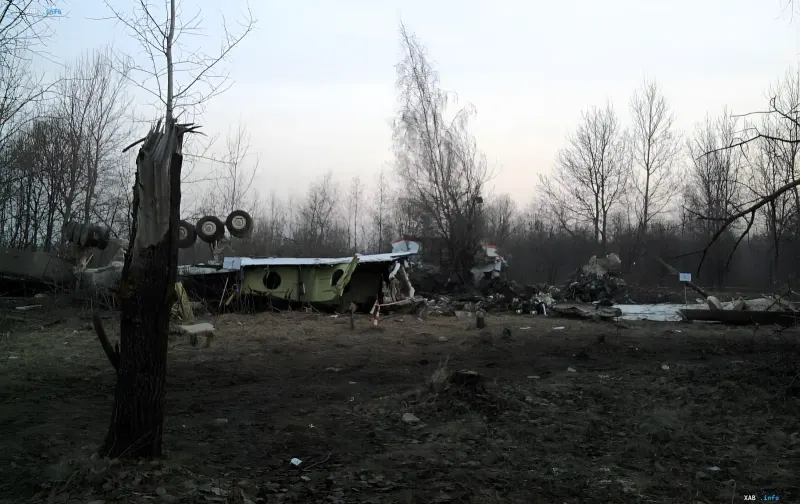
At approximately 10:41:00, the aircraft struck a birch tree with its left wing at a speed of about 270 km/h, tearing off the outer part of the wing. Due to uneven lift distribution, the machine banked sharply to the left and began rotating around its longitudinal axis, after which it collided with other obstacles and hit the ground in an inverted position—to the left of the centerline, short of the runway. Nowak also reported on one of the experts' hypotheses: the barometric altimeter settings may have been altered in such a way that the TAWS system failed to trigger for a certain period. The "terrain ahead" warning did sound about a minute before the crash, and the change in altimeter settings, according to the prosecutor, occurred almost three seconds after the first signal—about 54 seconds before impact. The reasons for this change are unknown; the speaker earlier mentioned that, in the experts' opinion, due to the changed settings, the crew "lost situational awareness of flight altitude," contributing to the catastrophe.
Conclusions and Legal Assessment
As a result of the impact, the aircraft was completely destroyed, killing 96 people, including Lech Kaczyński and his wife, members of the Polish delegation, and the crew. According to the experts' findings, this was a CFIT (Controlled Flight Into Terrain) accident—a collision between an airworthy plane and the ground. Nowak clarified that the press conference focused on the content of the expert report—the conclusions and assessments of specialists—rather than the conclusions of the prosecutor's office itself or individual prosecutors. At the same time, the content of this evidentiary material, he said, will be taken into account in further proceedings.