2026 entered the history of electromobility as a milestone when the technology of all-solid-state batteries (ASSB) ceased to be a laboratory fantasy and began its journey to the assembly line. According to the analytical agency TrendForce, key market players — Toyota, Honda, Nissan, and Samsung SDI — have successfully completed small-scale production stages and moved to comprehensive testing of the technology under real-world conditions. This marks a fundamental shift in the Technology Readiness Level (TRL), which has risen from theoretical stages (TRL 1–3) to practical process validation (TRL 5–6).
From laboratory samples to serial tests
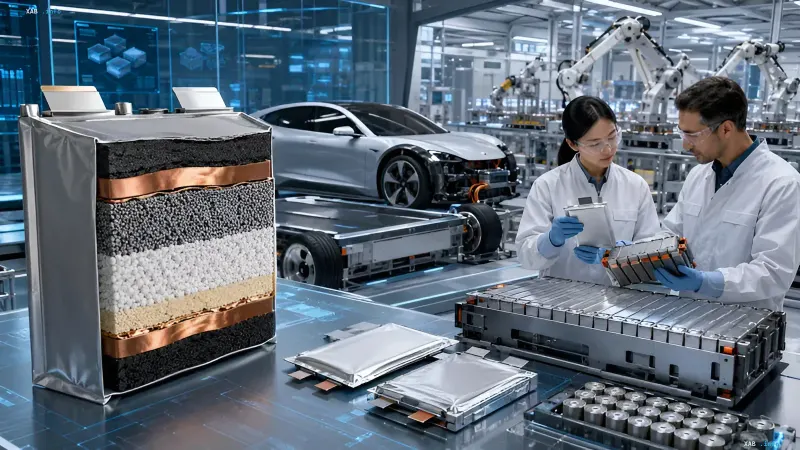
While just a few years ago the development of solid-state batteries was limited to formulating ideas and initial concept validation, today the focus has shifted to performance stability and scalability. In the first half of 2026, Japanese and South Korean manufacturers demonstrated the ability to produce working cells on pilot lines. Nissan’s success deserves special attention: the company successfully tested an automotive cell with an innovative 23-layer pouch structure. Results showed that the new battery outperforms traditional lithium-ion counterparts with liquid electrolytes in terms of capacity retention and longevity.
The Chinese surge and global competition
While Japan and South Korea lead in reliability, Chinese giants — CATL, BYD, and FAW — are actively accelerating their pace. They are developing their own pilot lines, approaching TRL 4–5 levels. This creates a tense competitive environment where every major corporation strives to launch full-scale serial production first, aiming to capture a market share that is projected to skyrocket in the next two years.
New horizons: from electric vehicles to air taxis
It is important to note that the application of ASSB is not limited to the automotive industry. Companies such as Samsung SDI, Maxell, Ilika, ProLogium, and Factorial are actively adapting the technology for drones and vertical take-off and landing aircraft (eVTOL), known as air taxis. The high energy density and safety of solid-state batteries make them an ideal solution for aviation and robotics. The ASSB market is forming across several sectors where compactness and operational performance are critical.
Raw material boom: lithium sulfide prices plummet
Technological development inevitably pulls the raw materials sector along. The main focus has been on sulfide solid electrolytes, causing a sharp surge in demand for lithium sulfide (Li2S). By mid-2026, global production capacity for this raw material exceeded 600 tons. Furthermore, a rapid price drop is observed: over the last six months, the price of lithium sulfide has fallen by more than half, reaching $219 per kg in June. Analysts predict that by 2027, production will grow to several thousand tons annually, signaling a full transition to mass production.