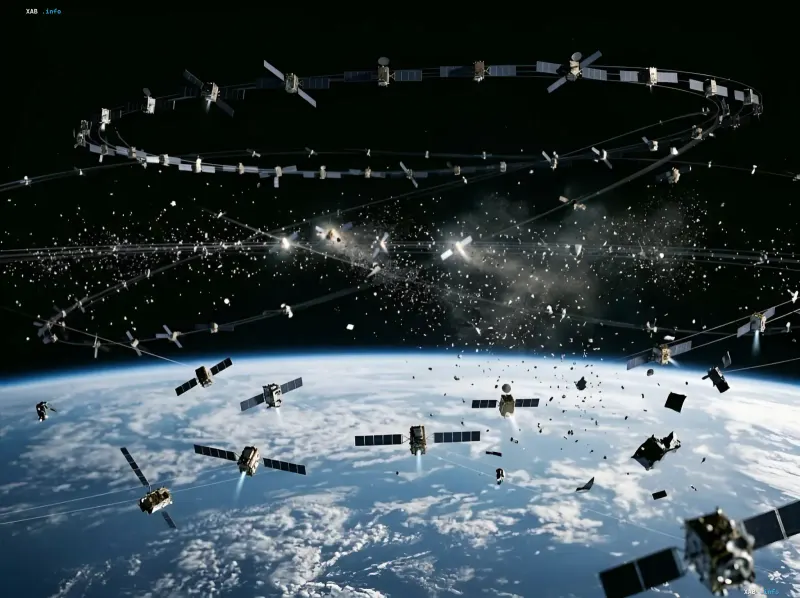
On August 17, 2026, humanity stands on the brink of a critical turning point in space exploration. According to a new fundamental analysis by Hugh Lewis from the University of Birmingham, current rates of satellite constellation deployment are leading to an inevitable catastrophic scenario. Currently, there are nearly 30,000 spacecraft in orbit, and regulators worldwide have received applications for more than 1 million additional satellites. If these plans are fully realized, the total number of spacecraft will approach 1.7 million, exceeding the critical stability limit of near-Earth space.
The Kessler Syndrome: From Theory to Inevitable Reality
The main threat lies in the so-called cascade effect, or the Kessler Syndrome. A collision between two large satellites generates thousands of fragments, each moving at orbital velocity and capable of destroying the next spacecraft, creating new debris. Lewis emphasizes that existing safety assessments traditionally consider risks to individual satellites, ignoring the collective behavior of entire constellations. However, a new mathematical model, accounting for the frequency of objects passing through specific zones, maneuverability, and deorbiting speed, shows that the system is already losing stability.
Critical Threshold Exceeded: 6 Constellations in the Danger Zone
The study analyzed 16 satellite constellations—both operational and in the planning stages. The results were alarming: 6 of them have already exceeded the threshold beyond which the amount of space debris begins to grow uncontrollably. Among these projects were major initiatives from the US and China. Another three constellations fell into an "unstable zone," where debris accumulates and the process随时 could turn into an uncontrollable avalanche. This means that even without additional launches, the current configuration of the orbital environment is already in a state of pre-catastrophic tension.
Why Quantity Isn't Everything: Vulnerability Factors
The critical threshold depends not only on the total number of spacecraft. In one of the constellations considered, just a few hundred satellites were sufficient to cause instability due to orbital placement specifics. Another small constellation entered a mode of uncontrolled debris growth because its small satellites lacked engines for collision avoidance maneuvers. This casts doubt on the effectiveness of current approaches to designing "satellite mega-constellations," where priority is given to cheapness and mass production rather than safety.
Solutions: Aerodynamics and Service Life
According to Lewis's calculations, the situation can still be saved if relatively minor changes are made to spacecraft design. For example, increasing the aerodynamic drag of satellites will allow them to deorbit faster after their mission ends, reducing the time they spend as potential projectiles. It is also proposed to extend the service life of satellites to reduce the number of replacement launches. However, given that deployment is in full swing in 2026, the question of whether regulators and corporations will have time to change the rules of the game before the avalanche begins remains open.