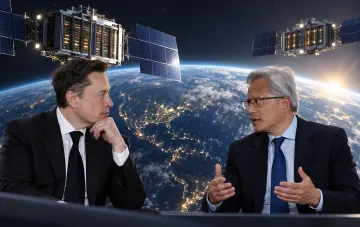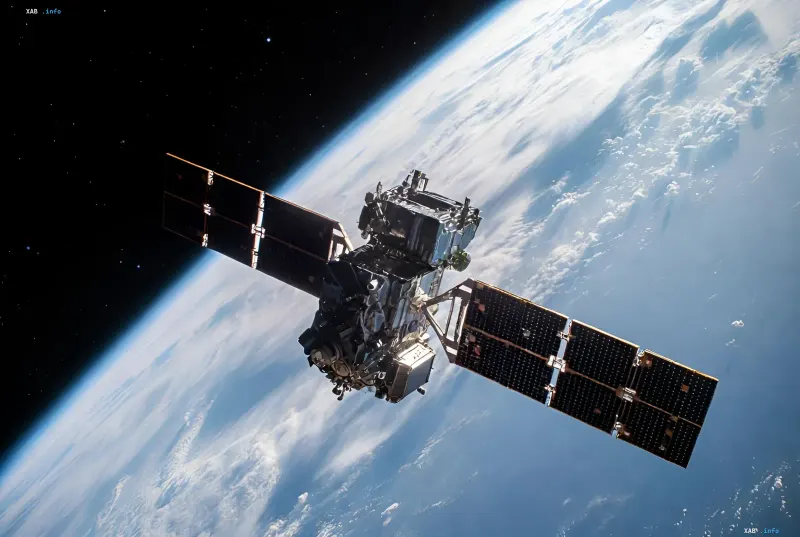
Analyst Jeff Pu from the investment firm GF Securities has presented a detailed forecast suggesting that Elon Musk's SpaceX is capable of deploying a 5-gigawatt AI computing infrastructure in low Earth orbit by 2028. According to the expert, implementing this massive project would require about 10,000 Nvidia Vera Rubin NVL72 computing racks, specifically adapted for space flight conditions. If the forecast proves accurate, it would involve creating the largest computing complex in human history operating outside the Earth's atmosphere.
Kessel Architecture: Compactness for Orbit
Analyst Pu has given these units the working name "Kessel." The key difference from standard server racks lies in a radically altered layout: instead of the standard 48U format, a horizontal construction only 9U high (about 40 centimeters) is proposed. This design is driven by two factors: the equipment must withstand significant mechanical loads during rocket launch and must not compromise the center of mass or the stability of the satellite in orbit. At the same time, the thermal output of individual GPUs in these racks, according to Pu, could reach 4 kilowatts—a metric that would require a massive cooling system on Earth but presents a far more complex challenge in the vacuum of space.
The Starmind Project: From Starlink to Orbital Data Centers
Computing satellites will become part of the strategic Starmind project, within which SpaceX intends to move AI data centers into orbit, leveraging experience gained from building and operating the global Starlink satellite network. According to the company, the first generation of AI1 units should provide up to 250 kilowatts of computing power each. The next generation, the analyst suggests, could support 350–400 kilowatts per unit. Scaling to the claimed 5 GW would require, by Pu's calculations, about 10,000 such racks, making the project not only a technological challenge but a logistical one: each rack must be delivered to orbit, integrated into an orbital platform, and powered.
The Main Engineering Challenge: Heat Dissipation
One of the central problems for space-based computing systems is efficient heat removal. On Earth, server racks are cooled by air or liquid, with heat dissipated into the atmosphere via radiators. In the vacuum of space, convection is impossible, and radiation remains the only way to get rid of heat. To solve this, SpaceX and Nvidia, according to Pu, are jointly developing a liquid cooling system that transfers thermal energy to external radiators. Elon Musk previously claimed that aluminum radiators in space could dissipate about 1300 watts of heat energy per square meter due to the extremely low ambient temperature. However, even with this metric, the total area of radiators for a 5-gigawatt complex would be colossal, requiring engineering solutions on the scale of entire orbital platforms.
Who is Jeff Pu and Why are His Forecasts Significant?
Jeff Pu is a GF Securities analyst known for accurately describing key technical specifications of unreleased Apple devices well in advance. Notably, he was the first to describe in detail the iPhone 15 Pro's transition to a titanium frame instead of stainless steel, accurately predicted the increase to 8GB of RAM in standard iPhone 16 models, and foresaw the introduction of 5x optical zoom in the iPhone 15 Pro Max camera and the adoption of USB-C. This reputation allows investors and the tech community to regard his new evaluations—including the forecast regarding SpaceX's orbital data centers—with heightened attention, although the forecast remains an analytical hypothesis rather than a confirmed corporate plan.
Currently, SpaceX has not published official confirmation of all the parameters mentioned by Pu; however, the emergence of a detailed analytical report with specific figures regarding architecture, hardware generations, and thermal characteristics suggests that the Starmind project is in an active engineering phase. If a multi-gigawatt orbital computing infrastructure becomes a reality by 2028, it will fundamentally change the economics of cloud computing and open up a new class of tasks for which ground-based data centers will no longer be able to provide the necessary power and bandwidth.