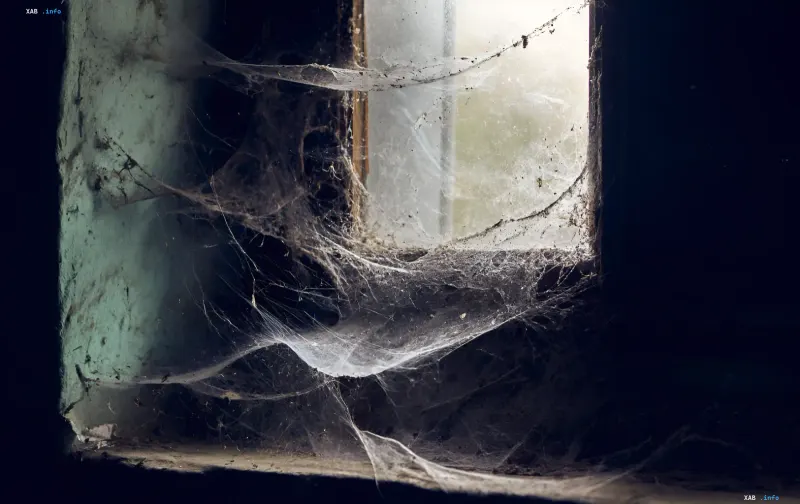
In a modern house, a spiderweb usually means one thing — it's time to sweep the corners with a broom. However, in folk beliefs, spiders and their webs were treated much more seriously: a web was not seen as a household nuisance but as a significant sign that people tried not to destroy unnecessarily. This is why in traditional culture the spider was often called a kind of "resident" of the house, to whom one had to be cautious.
Spiderweb as a sign of well-being
In many folk beliefs, a spider settling in the house was considered a good omen. Its appearance could be associated with abundance, pleasant news, or changes for the better. Special significance was attached to a spiderweb noticed in a secluded corner, by the window, or above the door: according to beliefs, it supposedly "retains" goodness and well-being within the house. Because of this, webs were not always removed immediately, and spiders were not killed.
Spider behavior and its interpretations
Certain signs concerned not the web itself, but the behavior of its owner. If a spider lowered itself on a web directly in front of a person, it could be perceived as a sign of future news or a meeting. A spider moving upwards was interpreted as a favorable sign, while a spider appearing on clothing could be linked to financial luck. At the same time, the text notes that such interpretations varied depending on the locality and specific tradition.
Contradictory data
There is no single "canonical" version in folk beliefs: some traditions attributed exclusively positive meaning to the spider and its web (abundance, news, protection of the house from troubles), while in others, as the material itself notes, a spider in the house could be associated with the approach of something bad. That is, the same phenomenon — a web in the corner — was interpreted differently in different local traditions: from a messenger of well-being to a warning sign. This is not a factual contradiction but a natural variability of folklore interpretations, which is important to consider in any generalization.
Practical explanation of the phenomenon
Ancestors could explain the appearance of a spiderweb not only through omens. A spiderweb literally showed that there were enough small insects in the house for spiders to feed on. Consequently, a large amount of web could be a common sign of conditions in the room, rather than a mystical signal. However, in folk beliefs, its appearance was not necessarily considered bad — on the contrary, the spider was perceived as a "resident" whom it was better not to disturb without need.
Why spiders were not killed
People were cautious towards spiders also due to ancient beliefs that they protect the house from troubles. Therefore, if the web had to be removed, it was advised not to destroy the spider but to carefully carry it out of the house. Today, a spiderweb has a quite practical explanation and is not a harbinger of future events, but folk omens are interesting because they show how ancestors tried to explain ordinary phenomena around them.