A new era of transparency is arriving in the music industry. As of mid-September 2026, streaming giant Spotify is implementing a major reform aimed at distinguishing between the creativity of real people and artificial intelligence. The platform is introducing mandatory labeling for artists whose public persona is AI-generated and is radically changing its recommendation algorithms to exclude content created by "AI personas."
Two badge categories: "AI Persona" and "Likely AI Persona"
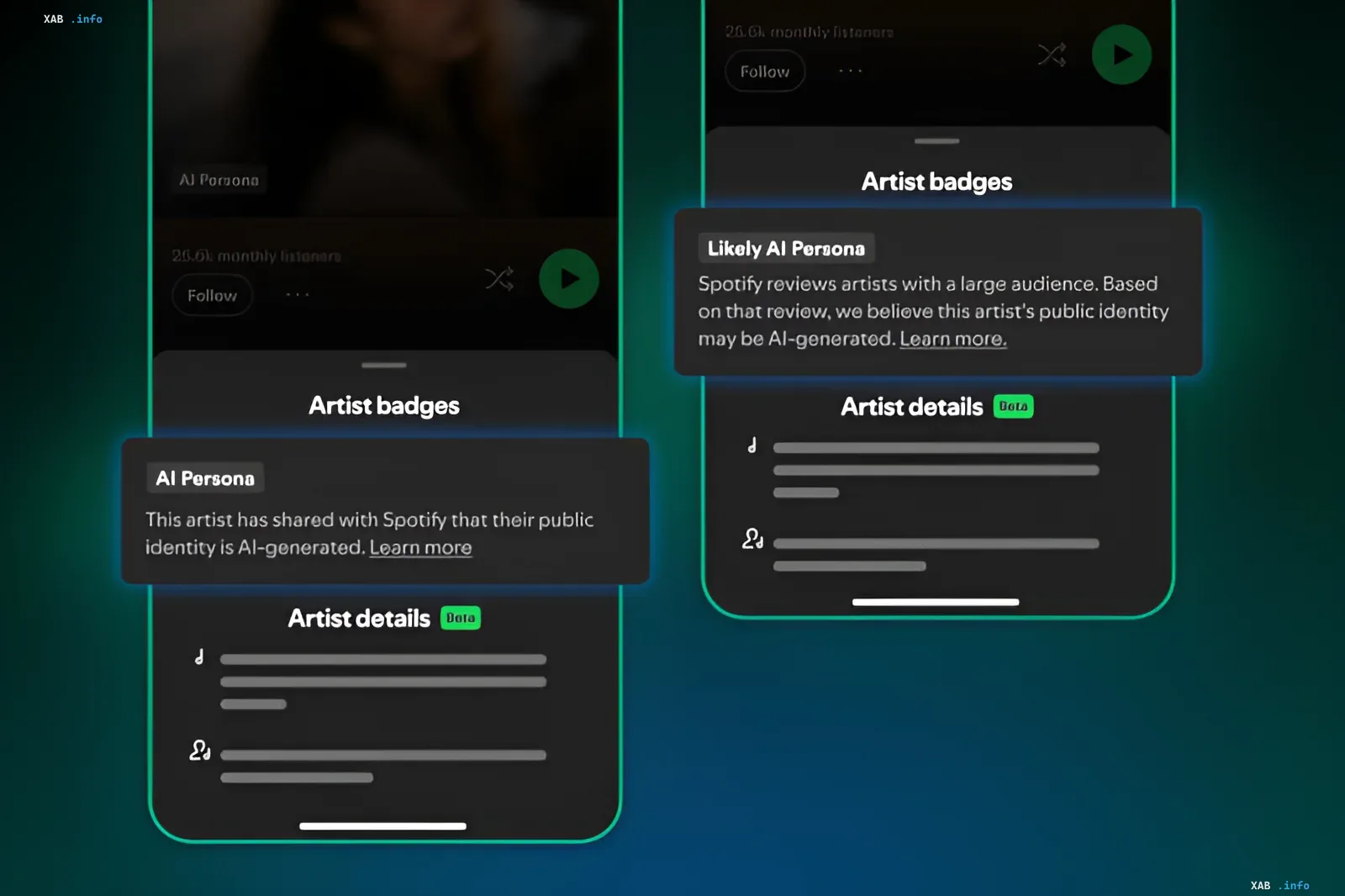
According to the platform's updated rules, new badges will appear in artist profiles. The first type of badge — "AI Persona" — will be assigned if the artist voluntarily confirms that their public identity is generated by artificial intelligence. However, Spotify does not intend to rely solely on the honesty of artists. A second category has been introduced — "Likely AI Persona."
This badge will be applied by the service's administration if their algorithms and manual checks reveal signs that the profile (including name and photorealistic images) was created using neural networks. Priority in verification will be given to artists with a large audience to protect users from mass spam and low-quality content often generated automatically.
Exclusion from recommendations and listener protection
The main consequence of the "AI Persona" badge will be the automatic exclusion of such artists' music from personalized recommendations. Spotify explains this as a response to user requests: listeners have expressed dissatisfaction with algorithms suggesting tracks from artists who appear to be real people but are actually digital constructs. The company states it will strive to highlight human creativity, filtering out "spam and low-quality content."
It is important to note that the badges concern the artist's persona, not the method of music creation. Currently, Spotify has no system for labeling tracks written with AI but performed by real people. The platform still relies on artist self-declaration regarding the use of neural networks in sound production.
Contradictory data and the scale of the problem
The introduction of badges comes against the backdrop of an acute content overproduction crisis. Data from Spotify's competitor, Deezer, shows that by August 2026, tracks created with AI already accounted for 50% of all daily uploads to the platform. This creates a serious burden on moderation algorithms.
There is a nuance in interpreting Spotify's actions. On one hand, the company claims to be fighting spam and low-quality content. On the other hand, critics may see this as an attempt to monopolize attention on "verified" artists. Spotify emphasizes that the "Likely AI Persona" badge is not a verdict: the artist will receive a notification and can appeal. In the future, a function allowing listeners to report suspicious profiles is also planned.
Verification system and the platform's future
To confirm the status of a real human, Spotify uses the "Verified by Spotify" badge. This creates a two-tier trust system: on one side — "human" artists with verification, on the other — "AI personas" with corresponding badges. If the system mistakenly tags an artist as AI, they can initiate a review to prove their reality and regain access to recommendations.