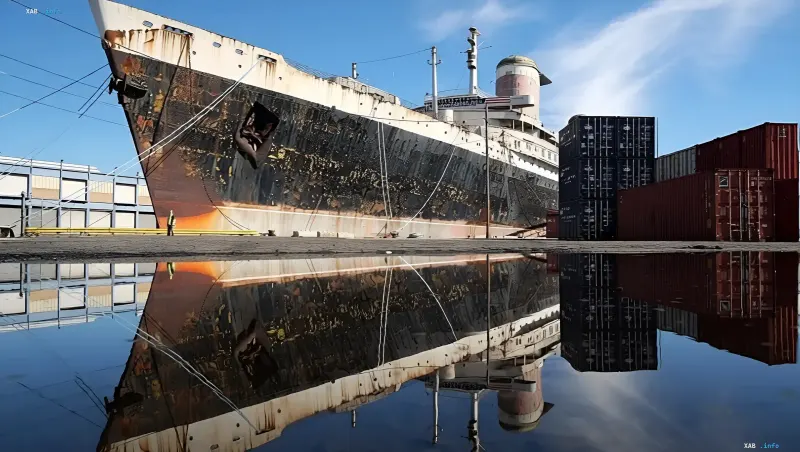
Once the world's fastest ocean liner, surpassing the Titanic in length and having crossed the Atlantic Ocean hundreds of times, is now set to become the world's largest artificial ocean reef. The vessel SS United States was intentionally scuttled off the coast of Florida: on Wednesday, November 11, a high-precision sinking operation was carried out without the use of explosives. The massive hull, approximately 302 meters long, is now intended to serve as a home for marine life and an underwater attraction for divers.
Nearly three decades of waiting
After the liner was unexpectedly retired in 1969, it sat at a pier in Philadelphia for nearly 30 years. While legal battles unfolded, the ship changed hands between various owners and remained docked at different piers. Before the vessel was acquired by the municipal authorities of a Florida county, several future scenarios were considered: in addition to a museum, there were proposals to use the liner as a floating hotel. Neither of these ideas was ultimately implemented. Last year, the SS United States was transported from Philadelphia to Alabama for cleaning and restoration work, and on Monday, it embarked on its final voyage—from Alabama to the city of Destin, Florida.
High-profile passengers
From 1952 to 1969, the liner carried members of royal families and celebrities across the Atlantic. Notable figures such as Marlon Brando, Coco Chanel, Duke Ellington, Salvador Dalí, Walt Disney, Judy Garland, and Cary Grant were among those on board. Former U.S. Presidents Harry Truman, Dwight Eisenhower, and John F. Kennedy traveled on the ship, and a young Bill Clinton crossed the ocean on it before his presidency. In 1962–1963, when the Mona Lisa was transported from France to the U.S., it was carried back on the SS United States.
Sinking without explosives and a new status
After the liner was purchased by a Florida county, it was decided to turn it into one of the many artificial reefs off the coast. However, a museum will still be created—a land-based one dedicated to the ship's history. The sinking operation was carried out without explosives, allowing for a controlled descent of the hull to the bottom of the Gulf of Mexico.
A fate that could not be changed
For a long time, activists unsuccessfully tried to secure the preservation of the liner and its transformation into a museum. The SS United States Conservancy, which led the fight to save the ship, is headed by Susan Gibbs, whose grandfather participated in designing the liner. Although the ship could not be saved, she noted that she is pleased that the story of the SS United States will continue. "It has always been an emphatically American symbol that brought many people together," she said in comments to CBS News, a BBC American partner.