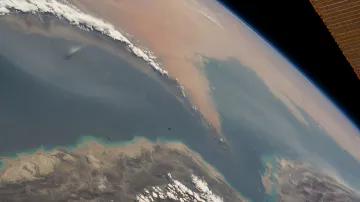
British long-distance swimmer Lewis Pugh, a UN Patron of the Oceans, swam part of the Strait of Hormuz over three days this week to draw attention to how the war with Iran threatens the region's ecosystem and wildlife. As CBS News notes, swimming in conditions where tankers are being attacked and blown up nearby was a different kind of challenge compared to the polar waters of the North Pole and Antarctica, where he had previously swum for environmental causes.
Swimming Under Fire
Wearing only swim trunks, goggles, and a cap with a UN logo, the athlete started from the Musandam Peninsula at the southern end of the strait and finished at Cape Hormuz, covering a total of about 9.3 miles (approximately 15 km). According to reports, Pugh became the first person to complete such a distance swim in these waters since the start of the war. According to him, just minutes after he entered the water on Monday, he heard two loud explosions that "shook the sea."
Escalation Around Hormuz
The swim took place during a period of notable escalation. On Saturday, Bahrain's Interior Ministry reported that Iran had attacked a civilian industrial facility, resulting in a fire and material damage, though there were no reported casualties. A US official told CBS News that Iran had attempted new attacks, but there were no strikes against American forces or military facilities in the region. This incident was, according to the publication, the fourth attempted Iranian attack on Bahrain in about a week—a sharp escalation after a relative two-month lull. The British maritime agency UKMTO, in turn, confirmed the attack on two tankers in the Strait of Hormuz on Saturday with no reports of casualties.
Deadlocked Negotiations
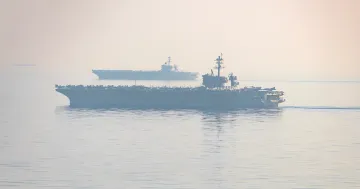
On the diplomatic front, the situation remains tense. Iranian Deputy Foreign Minister Kazem Gharabadi reported on Saturday that a Qatari delegation had visited Tehran the previous evening and held two hours of talks, without disclosing details. Meanwhile, US-Iran negotiations on ending the war have reached a stalemate in recent months. Iranian Foreign Minister Abbas Araghchi stated that the current regional negotiations "must be given a chance" and the American blockade of the Strait of Hormuz "must be rationally lifted," adding that as long as Iran's demands are not met, discussing the opening of the strait is "meaningless." Tehran's conditions include ending the war on all fronts, unfreezing Iranian assets, lifting oil sanctions, and ending the US counter-blockade of Iranian ports.
Trump and the "Permanent Deal"
US President Donald Trump stated in a Saturday interview that he wants to reach a "permanent" deal with Iran that would prevent the country from obtaining nuclear weapons in the future, emphasizing that he would not allow this "neither under an incompetent president in four years, nor in 15, nor in 20." He also claimed that he had already "eliminated two regimes," without specifying details; notably, the former Supreme Leader Ali Khamenei was killed during initial strikes on Iran that launched the war in February 2026, and since then his son, Mojtaba Khamenei, has held the title. Concurrently, families of fallen American soldiers (Gold Star families) told CBS News that they had been presented with unclassified results of an internal investigation into one of the first strikes against US forces during Operation "Epic Fury"—on March 1, a drone attacked a command post in Kuwait (Shuaiba Port), resulting in the deaths of six US Army Reserve soldiers. The official report has not yet been released, but the Pentagon indicated it could be made public within days.