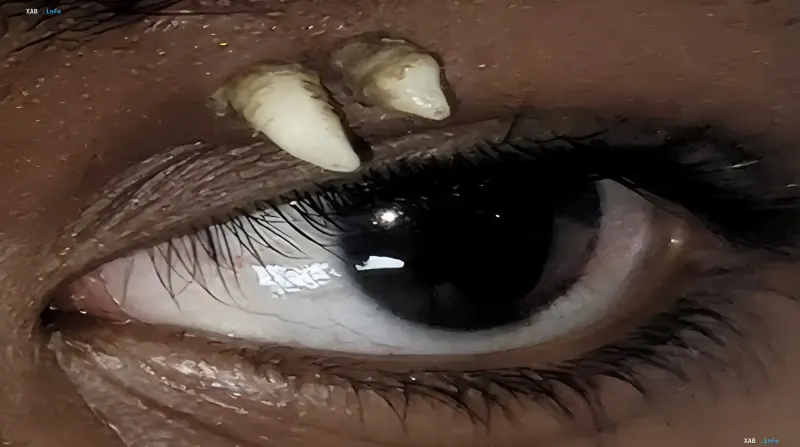
An extremely rare anatomical anomaly has been recorded in India, causing a wide resonance in the medical community. A 16-year-old teenager developed fully formed teeth within the bone tissue of his left eye socket, which subsequently grew outward through the skin. The case, reported by local medical sources, has attracted intense attention from surgeons and specialists in rare developmental pathologies.
From ordinary swelling to a medical discovery
According to available data, the medical history began unnoticed: the patient developed an unusual swelling in the area of the left eyelid, which gradually increased over time. Primary care physicians initially mistook it for a common inflammatory or allergic soft tissue lesion. However, a few months later, the clinical picture changed dramatically—two sharp, white, and hard bone formations broke through the skin above the eyelid, becoming visible to the naked eye. It was at this stage that the case ceased to be routine and required in-depth diagnostics.
What X-rays and tomography revealed
The results of thorough radiological and tomographic examinations confirmed what initially seemed incredible: the white formations protruding through the skin turned out to be full-fledged teeth that had developed abnormally entirely outside the oral cavity—within the orbit of the eye socket. Such localization of dental tissue has nothing to do with normal anatomical structure and is extremely rare in global medical practice.
Cause: cell ectopia during the embryonic period
Specialists assessed this condition as a rare teratoma or developmental defect resulting from improper cell migration—ectopia—during the embryonic formation of the organism. For this reason, the dental tissue germs were laid down not in the jaw, but in the bone structure of the eye socket, where they continued their development throughout the patient's childhood, remaining hidden until the swelling and growth of the formations made them visible.
Surgery and patient condition
Doctors took emergency measures to avoid damaging the eyeball and optic nerves. A team of specialists performed a high-precision microsurgical operation, during which both teeth were completely removed from the eye socket without harming the patient's vision. Currently, the teenager's condition is assessed as stably good; he is undergoing rehabilitation under medical supervision.
Significance of the case for medicine
Such anomalous phenomena that can occur in the human body clearly demonstrate how crucial modern diagnosis and timely medical assistance are for preserving health. The case from India adds to the narrow list of documented examples of ectopic dental tissue development in literature and will be useful to specialists in diagnosing similar, at first glance "unexplained," formations in the head and facial region.