Financial Breakthrough: Revenue Hits Records, but Profit Under Pressure
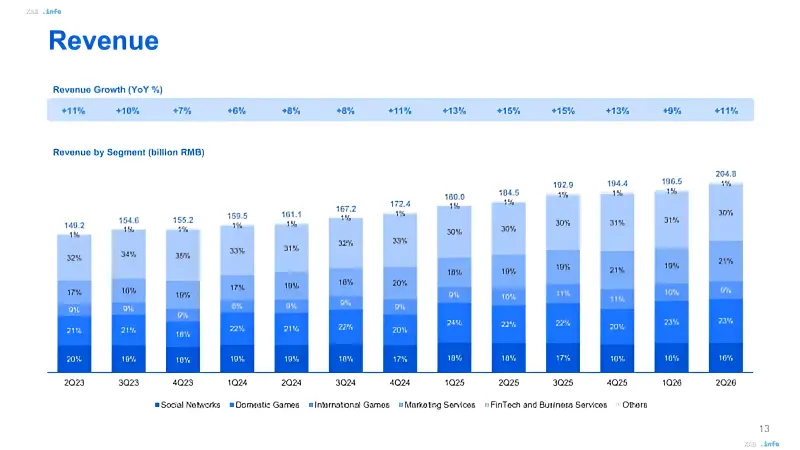
As of the current date, August 16, 2026, Chinese tech giant Tencent Holdings released its second-quarter report, demonstrating impressive business resilience. According to unaudited consolidated results, the company's revenue reached 204.8 billion yuan ($30.3 billion), an 11% increase year-over-year. This result exceeded the LSEG analyst consensus forecast of 202.2 billion yuan. However, behind the facade of revenue growth lies a complex economic reality: net profit attributable to shareholders under IFRS standards grew by only 0.7% year-over-year, settling at 56 billion yuan ($8.3 billion). This figure fell short of market expectations of 61.8 billion yuan, signaling serious pressure on business margins.
The situation appears more optimistic when considering profit under alternative standards (Non-IFRS). Net profit, excluding certain one-off items and amortization, amounted to 68.4 billion yuan ($10.1 billion), showing a 9% increase. This gap between IFRS and Non-IFRS figures clearly illustrates the scale of capital investments the company is making this year, particularly in the field of artificial intelligence.
Capital Expenditures: The AI Arms Race
The main theme of Tencent's report was the explosive growth in capital expenditures (CAPEX). In the second quarter of 2026, the company invested 52.8 billion yuan ($7.8 billion), which is 176% higher than a year ago and 66% higher than the first quarter of the current year. For comparison, total capital expenditures for all of 2025 were around 79 billion yuan, and for 2024, they were 77 billion. Thus, in just one quarter of 2026, Tencent invested an amount comparable to the annual investments of previous years.
The company indicated that AI investments will increase even further in the second half of 2026. Tencent President Martin Lau, during a conference call with analysts, expressed confidence in the ability to make such significant investments. He justified this with the "significant growth potential" and "clear downside protection." Lau emphasized that the demand for computing resources is so high that Tencent could recoup its costs "almost immediately" if it chose to act as a non-cloud company by renting out capacity.
Strategy: From Capacity Leasing to Proprietary Models
The company's strategy for 2026 is clearly divided into two directions. On one hand, Tencent sees the opportunity for rapid monetization of its computing power. According to Lau, the company is receiving leasing offers with a profit margin of over 30% compared to the equipment purchase price just a few months ago. On the other hand, Tencent is implementing a broader strategy, allocating a significant portion of new resources to the creation of its own AI models.
Strategy Director James Mitchell noted that the company is focusing on deploying and popularizing its own AI applications to take a leading position in the Chinese market. Priority is given to services that can ensure "excellent long-term economic returns." Key products here include WorkBuddy — an office assistant representing a swarm of agents for task execution, and CodeBuddy — a code generation tool that accelerates cloud migration and creates demand for Tencent's cloud services.
Segment Analysis: Games and Advertising as Growth Engines
Revenue analysis by segment shows that growth is driven by several key drivers. Revenue from value-added services, including the gaming business, grew by 8% to 98.4 billion yuan ($14.6 billion). A significant boost came from advertising: revenue from marketing services grew by 22% to 43.6 billion yuan ($6.5 billion). This growth is stimulated by the integration of AI into the Weixin ecosystem, which allowed for the optimization of pricing and the effectiveness of advertising campaigns.
Revenue from financial technology and business services also showed positive dynamics, growing by 9% to 60.3 billion yuan ($8.9 billion). In this segment, demand for AI-related cloud services remains a key growth factor. Thus, Tencent is successfully transforming its traditional businesses by integrating artificial intelligence technologies to increase their efficiency and monetization.