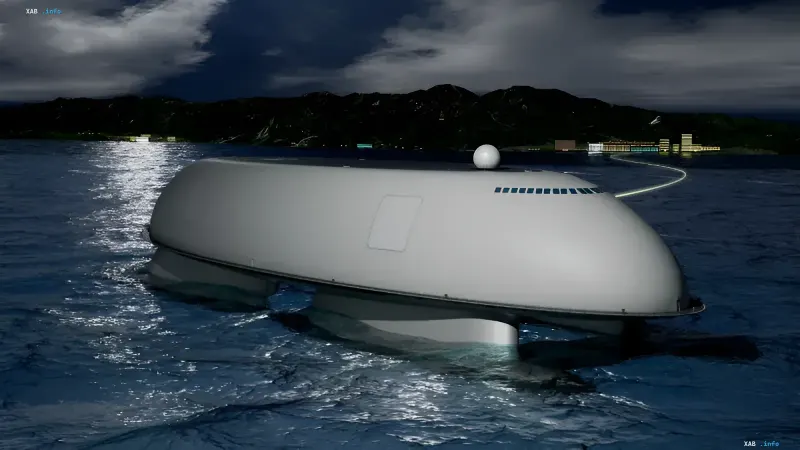
Amidst unprecedented growth in demand for computing power and electricity driven by the artificial intelligence boom, the industry is seeking unconventional solutions. A joint venture between shipbuilding company InMar Technologies and energy technology developer OptiFuel, operating under the brand Optimal Transit, has announced a revolutionary project — a series of floating data centers named Kraaken. This is not merely servers in a container on water, but an autonomous ecosystem capable of generating energy, desalinating water, and supporting critical infrastructure.
Digital Ocean Thermal Technology: Energy from the Ocean's Depths
The key feature of Kraaken is complete energy autonomy. Unlike traditional floating data centers that rely on shore-based power grids or diesel generators, Kraaken utilizes patented Digital Ocean Thermal (DOT) technology. The system operates on a multi-stage Rankine cycle, converting ocean thermal energy into electricity. Furthermore, the installation recovers "waste" heat generated by the data center equipment itself, creating a closed-loop efficiency cycle.
Developers state that the platform uses a forced induction (supercharging) system and "green" ammonia synthesis, enabling electricity generation without carbon emissions. This solution is positioned as ideal for regions experiencing shortages of clean energy and fresh water.
Two Platform Variants: From 10 to 100 MW
The company offers two configuration variants of the Kraaken platform, differing in power and size. The first variant is a vessel 250 feet (approximately 76 meters) long, capable of delivering 10 to 20 MW of computing power. The second, larger variant is a 500-foot (152 meters) vessel with a capacity of 50 to 100 MW.
Special attention is paid to the "Blue Economy Vital 100MW Kraaken" concept. This unit can generate up to 40 MW of clean baseload electricity for transmission to shore, leaving 60 MW for its own AI computations. Simultaneously, a vacuum desalination plant using excess heat can produce up to 30,000 cubic meters of fresh water per day, sufficient to meet the needs of hundreds of thousands of people.
SWATH Concept and Mobility in Crisis Situations
The Kraaken design is based on the Small Waterplane Area Twin Hull (SWATH) concept. This architecture provides exceptional stability for the platform in stormy conditions, allowing it to operate year-round from the equator to Arctic latitudes. The platform is equipped with high-speed optical and satellite communications, guaranteeing uninterrupted data transmission.
A crucial advantage of Kraaken is its mobility. In the event of a threat from natural disasters, such as tsunamis or hurricanes, the platform can independently unmoor and move to a safe zone at speeds up to 16 knots. This makes it an ideal solution for deploying infrastructure in risk zones or supporting affected regions.
Economic Efficiency and Competition
According to preliminary estimates by Optimal Transit, building a 100 MW offshore data center will cost less than $500 million (excluding IT equipment costs). For comparison, constructing a land-based facility of similar capacity could cost between $0.9 and $1.5 billion. Additionally, floating data centers allow for significantly faster commissioning than traditional capital projects.
However, the floating data center market is becoming increasingly competitive. Singapore's Keppel has begun work on a 25 MW facility, scheduled for launch in 2028. American company Panthalassa is developing solutions using wave energy, while giants like Seatrium and Samsung are also investing in offshore computing power.
Contradictory Data
Despite ambitious claims, the Kraaken project is currently at the concept stage. Sources lack specific information on the physical realization stage of the vessel, when a prototype launch is planned, or whether contracts with operators have already been signed. While Optimal Transit asserts that the solution is based on "time-tested technologies," skeptics may question the reliability of integrating such complex systems (desalination, power generation, AI clusters) into a single floating module without actual open-sea testing.