Kharkiv Mayor and Head of the Association of Frontline Cities and Communities, Ihor Terekhov, has initiated the expansion of the city's emergency response system to other Ukrainian cities and communities. The initiative was presented at a meeting of the Coalition Council with the participation of Prime Minister of Ukraine Serhiy Koretsky, representatives of the Verkhovna Rada, specialized ministries and services, regional military administrations, and communities. According to Terekhov, the Kharkiv model can serve as the basis for a unified nationwide standard of civil protection and operational response, adapted to the needs of different territories.
From American Experience to Ukrainian Standard
The idea of creating a situational center in Kharkiv, as the mayor noted, originated even before the full-scale war began. At that stage, the city studied the American experience of emergency management, which later formed the basis of the Kharkiv model. Today, this experience, tested under real combat conditions, is offered as a ready-made platform for replication. Terekhov emphasized that the standard covers the entire response cycle: from warning the population about danger and locating the strike site to eliminating consequences, providing assistance to victims, and restoring vital infrastructure.
How Service Coordination is Structured
The key objective of the Kharkiv approach was to unite the work of multiple agencies within a single operational space. The system involves representatives of the city authorities, the State Emergency Service of Ukraine, patrol police, emergency medical care, energy, and gas services. Direct interaction with the Armed Forces of Ukraine has also been established. At the same time, each service retains its powers but acts in coordination with others without additional delays for finding those responsible and internal approvals. Terekhov emphasizes that having modern equipment, professional rescuers, and equipped hospitals does not guarantee prompt assistance if information between services is transmitted with a delay and people waste minutes on bureaucratic procedures.
30 Seconds Instead of Five Minutes
The practical results of the Kharkiv system are recorded in concrete figures. Over 86 weeks of operation, the duration of air raid alerts in the city decreased by 39.75%, which, according to the mayor, allowed residents to "live and work in a completely different way." A specialized video surveillance system made a significant contribution: the time to determine the location of an enemy strike was reduced from five minutes to 30 seconds. This allows for a quicker assessment of the situation, initiation of a response, and involvement of the necessary services. For coordination on the ground, the city uses specialized radio communications, including warning workers about the threat of repeated shelling. According to Terekhov, city services can now gather at the strike site within five to six minutes.
Municipal Services on the Frontline
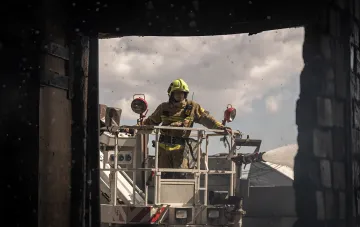
Municipal enterprises play a special role in the response. Their employees are among the first to arrive at strike sites: clearing rubble, helping rescuers, shutting off damaged utilities, and restoring electricity, water, and heat supply. This work is often carried out under the threat of repeated shelling. Terekhov appealed to communal sector workers with a call to realize that their daily activities in wartime conditions are part of saving human lives.
A Comprehensive Standard, Not Just a Situational Center
The Kharkiv security standard, as the mayor explained, is not limited exclusively to the work of the situational center. It is a comprehensive approach to preparing the city for emergencies, which includes equipping shelters, forming material reserves, ensuring backup power supply, training specialists, and conducting regular drills. Terekhov noted that even the best coordination cannot provide proper protection without the necessary resources, so scaling the model to other cities must be accompanied by appropriate funding and infrastructural support.