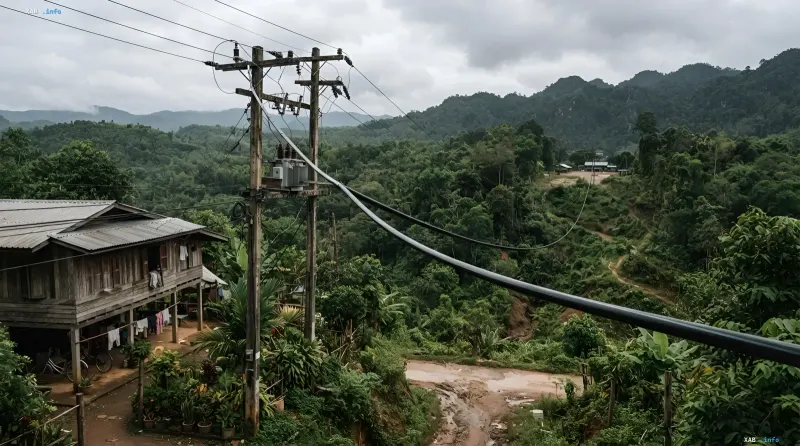
In the border province of Kanchanaburi in southwestern Thailand, law enforcement agencies have discovered an illegal fiber optic line used to transmit internet traffic across the state border into Myanmar. According to the South China Morning Post (SCMP), the cable, measuring about 350 meters in length, connected Thai territory to a facility on the Myanmar side that reportedly operated an internet scam center and an illegal casino. The discovery of the line was the result of an inspection of two village houses that showed abnormal traffic consumption figures.
How Abnormal Traffic Exposed the Illegal Line
Police arrived in the village of Nong Lu following reports of suspicious activity in several residential structures. Officers' attention was drawn to two dilapidated village houses, each of which consumed a daily volume of internet traffic comparable to the needs of an entire village. Such a discrepancy between the nature of the property—an old residential building—and the scale of network traffic became a key indicator that led law enforcement to the illegal infrastructure. It was the inspection of one of these houses that led to the discovery of the cable itself.
350 Meters Across the Border: The Technical Side
Upon inspecting the site, a 48-core fiber optic cable with a robust protective jacket was discovered. The line was strung on utility poles and stretched for approximately 350 meters, crossing the state border. According to preliminary data, this configuration allowed internet traffic to be transmitted from Thailand to Myanmar bypassing standard licensed telecommunications infrastructure. The use of a multi-core cable with a reinforced jacket indicates that the line was designed for the stable transmission of a significant volume of data rather than a single connection.
Three Pagodas Pass and the Cyber Scam Network
The area of Nong Lu village serves as one of the approaches to the Three Pagodas Pass on the border with Myanmar—a territory long known as a hub for cybercriminal activity. According to SCMP, the discovered cable likely provided connectivity for a scam complex located on the Myanmar side, which may have included an illegal casino and a unit engaged in internet fraud. Thus, the Thai side was used as an entry point into the network, allowing cross-border data transfer controls to be bypassed.
What's Next: Investigation and Infrastructure
At the time of publication, the case is at the preliminary data stage: law enforcement has confirmed the fact of the illegal line's discovery and its parameters, while the purpose of the facility on the Myanmar side—a scam complex with a casino—is currently formulated as an assumption. The case demonstrates how criminal groups are increasingly building their own telecommunications infrastructure in border areas, relying on physical border crossings where communications control is lax. Further investigation will likely focus on identifying the operators of the line and connections with scam centers operating on the Myanmar side.