Kyiv, August 7, 2026. Amidst a protracted conflict and ongoing shelling, public opinion in Ukraine has undergone fundamental changes. A fresh report by the Kyiv International Institute of Sociology (KIIS), published today, August 7, reveals a complex and, at first glance, contradictory picture of sentiments. While war fatigue previously dominated, Ukrainians are now demonstrating an unexpected rise in principled stands regarding territorial integrity, while simultaneously showing pragmatism regarding the cessation of hostilities.
60% Against Losing Donbas: The Territorial Question Becomes a 'Red Line'
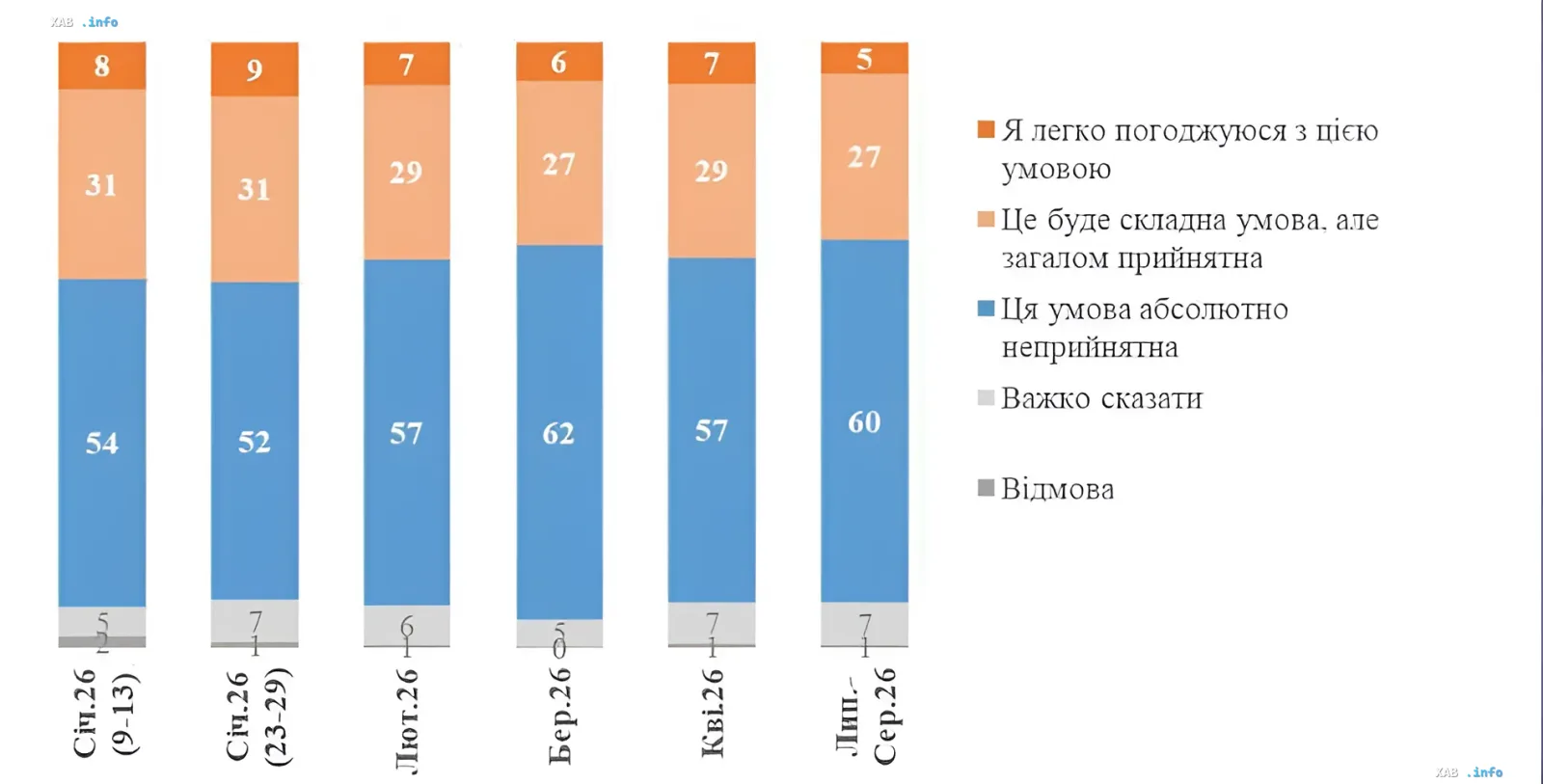
The key finding of the new survey, conducted from July 20 to August 3, 2026, concerns Ukrainians' willingness to make territorial concessions. Sociologists asked a direct question: Are respondents willing for Ukraine to give up all of Donbas (including unoccupied parts) in exchange for security guarantees? The results were harsher than expected.
The numbers speak for themselves: 60% of Ukrainians are categorically against handing over all of Donbas to Russian control. This is 3 percentage points higher than in the spring. The share of those willing to support such a scenario has dropped to 33% (in April, it was 36%).
This trend is particularly noticeable in Kyiv. Despite the capital currently being subjected to active ballistic missile attacks, Kyiv residents' willingness to make concessions has dropped. If in April 34% of the capital's residents allowed for giving up Donbas, now it is only 26%. The fear of shelling no longer outweighs the anger towards the enemy and the desire to preserve sovereignty.
The 'Freeze' Scenario: 59% Ready for Compromise Without Loss of Territory
However, to understand the full picture, one cannot ignore the second scenario, which sociologists also studied in this report. It radically changes the perception of the situation. Sociologists asked citizens about their willingness to support a 'freeze' of the war along the current front line. The condition was the absence of official recognition of territories by Russia, but the presence of security guarantees and funding for reconstruction from the West.
Here, the results were opposite: 59% of Ukrainians are ready to support this option. Most of them note that they would do so 'without joy', viewing it as a forced but necessary step for survival. People are not ready to voluntarily give up all of Donbas (including controlled Kramatorsk and Sloviansk), but are ready to accept the fixation of the current front line to stop the fighting.
Demographic Split: Youth Seek an Exit, Older Generation Seeks Resilience
The survey also revealed age differences in the perception of the future. Young people (18–29 years old) remain more inclined to compromise than the older generation, although their positions are changing. Among the youth, 42% are ready to consider a scenario with concessions on Donbas, although earlier in the spring, more than half (54%) were. This suggests that even in the youth environment, the understanding of the value of territorial integrity is growing.
At the same time, 61% of Ukrainians in general stated that they are ready to endure the war 'as long as it takes'. Illusions about a quick end to the conflict have practically disappeared: 45% of respondents believe the war will last at least until the second half of 2027. This testifies to the psychological adaptation of society to a long-term crisis.
Contradictory Data
There is an important nuance in the interpretation of KIIS data that requires attention. On the one hand, statistics show an increase in categoricalness (60% against concessions), which can be interpreted as a strengthening of patriotic spirit. On the other hand, the statistical error of the survey (usually around 3%) means that the difference between the April and August figures regarding Donbas (36% vs 33%) may be on the verge of statistical error.
However, if looking at the aggregate data, the 'contradiction' between refusing Donbas and agreeing to a freeze is not an error. These are two different scenarios: the first implies a legal loss of territories, the second — a factual fixation of the front line without legal recognition. The difference of 27 percentage points between support for the 'freeze' (59%) and support for 'giving up Donbas' (33%) is statistically significant and confirms the thesis that Ukrainians are ready for a pragmatic peace, but not for capitulation.
Conclusion: From Fatigue to Pragmatic Hardness
The conclusions of the KIIS report from August 7, 2026, paint a portrait of a society that has become harder on issues of territorial integrity, but more pragmatic on issues of the tactics of ending hostilities. Ukrainians are no longer ready to simply 'give away' territories, but are ready for complex negotiations that will allow preserving sovereignty, even if this requires a temporary 'freeze' of the conflict. This is a signal for politicians: society is ready for compromises, but only on terms that will not be perceived as betrayal.