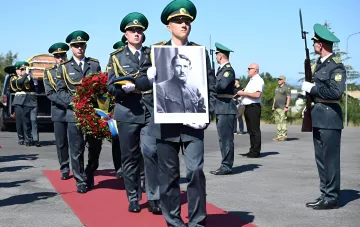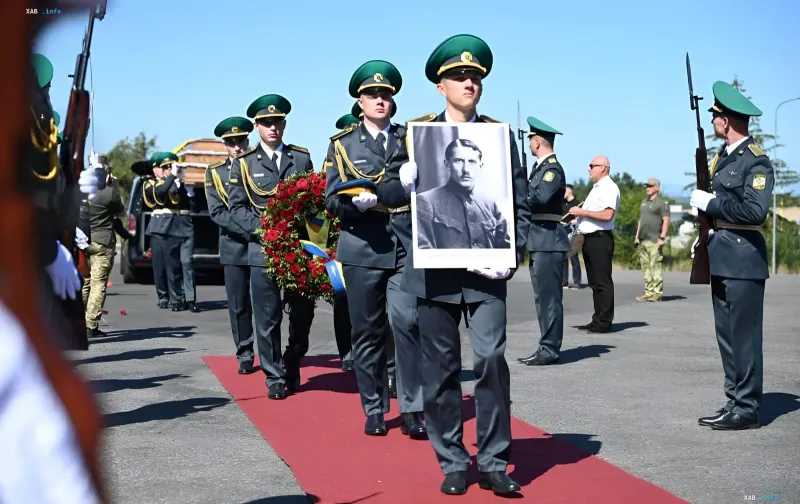
On August 13, 2026, a solemn ceremony took place in Kyiv for the reburial of Yevhen Konovalets' remains — one of the key ideologues and organizers of the Ukrainian national movement during the interwar period. His remains were returned from the Netherlands, where he was buried after his death in 1938. This event became part of a large-scale state campaign to reburial figures who fought for Ukrainian statehood and sparked wide resonance both within Ukraine and abroad.
From Student to Colonel of the UNR
Yevhen Konovalets was born in 1891 in the settlement of Zashkiv near Lviv. After receiving a legal education at Lviv University, he became actively involved in public and political life even during his student years, leading Ukrainian student organizations and working in the educational society "Prosvita". The First World War and subsequent liberation events revealed his military and organizational talent. He served in the Austro-Hungarian army, endured Russian captivity, and managed to escape to Kyiv.
Konovalets played a decisive role in suppressing the Bolshevik uprising at the "Arsenal" factory in January 1918, as well as in restoring the Directory of the Ukrainian People's Republic after the Battle of Motovylivka. Despite his merits, he categorically refused to hold high political posts, seeing himself primarily as a military builder of the state.
Creation of UVO and OUN: Struggle in Exile
The defeat of the Ukrainian national revolution did not stop the colonel. In exile, unlike many contemporaries who had lost hope in politics, Konovalets decided to continue the fight for the Ukrainian state. In 1920, he founded the Ukrainian Military Organization (UVO), which was supposed to provide armed resistance to the Soviet and Polish regimes that had established control over Western Ukraine.
In 1929 in Vienna, Konovalets united various nationalist groups into the Organization of Ukrainian Nationalists (OUN). He built an extensive network of OUN cells in Europe and North America, established cooperation with the governments of Lithuania, Germany, and Japan. However, he did not have time to take part in the new active phase of the struggle for Ukrainian independence — his life was cut short as a result of an NKVD plot.
Liquidation in Rotterdam: Stalin's Order
Moscow saw Konovalets as the main systemic enemy. Joseph Stalin personally ordered his liquidation. On May 23, 1938, in Rotterdam, an NKVD agent, Pavel Sudoplatov, handed Konovalets explosives disguised as a box of chocolates. From the powerful explosion, Konovalets died on the spot. He was buried in the local Crosswijk cemetery, where he lay for almost 90 years until his return to Ukraine.
Contradictory Data
In the official historical discourse of Poland, Yevhen Konovalets is an exclusively negative figure. Polish authorities of the interwar period classified UVO and OUN as terrorist groups, and the colonel himself was considered an organizer of anti-state underground. After the First World War, Western Ukraine became part of the restored Poland, where the Ukrainian population expected autonomy but faced a policy of Polonization and assimilation. In response, UVO and OUN moved to resistance actions, including armed attacks, sabotage, and the murder of Polish officials.
The most notorious action was the murder in Warsaw of the Polish Minister of the Interior, Bronisław Pieracki, in 1934 — direct revenge for repressions against the Ukrainian population. Before this, there were attempts on Józef Piłsudski and Stanisław Wojciechowski. In response, Poland launched mass repressions, and court proceedings against the organizers, including Stepan Bandera, made the OUN known worldwide.
The second factor of Konovalets' rejection in Poland is his international policy. UVO and OUN sought support from external forces seeking to revise borders in Europe. The main partner was Germany — first the Weimar Republic, then the Third Reich. German intelligence, the Abwehr, provided the OUN with funding and weapons. Although the OUN and UPA later fought against the Nazis, Polish historians regard this as cooperation with Warsaw's enemies.
Konovalets was also actively supported by the government of Lithuania, which was in a state of "cold war" with Poland due to the annexation of Vilnius in 1920. In official Polish historiography, a direct line is drawn from the activities of UVO and OUN in the 1920s–1930s to the Volhynian tragedy of 1943. Konovalets is often called one of the ideological fathers of "Ukrainian radical nationalism".
Significance of the Return of Remains for Modern Ukraine
The return of Konovalets' remains to Ukraine became a symbol of recognition of his contribution to the struggle for independence. For many Ukrainians, he remains a hero who did not surrender in the face of imperial regimes and continued the fight even in exile. However, for Poland and other countries in the region, this event evokes complex emotions, reminding of painful pages of history related to nationalism, terrorism, and cooperation with Nazis.
Nevertheless, the return of Konovalets' remains did not cause such an emotional storm in Poland as was the case with other figures of the Ukrainian national movement. Perhaps this is due to the fact that his role in history is perceived ambiguously: on the one hand — as the creator of the OUN, on the other — as a victim of Stalinist terror.