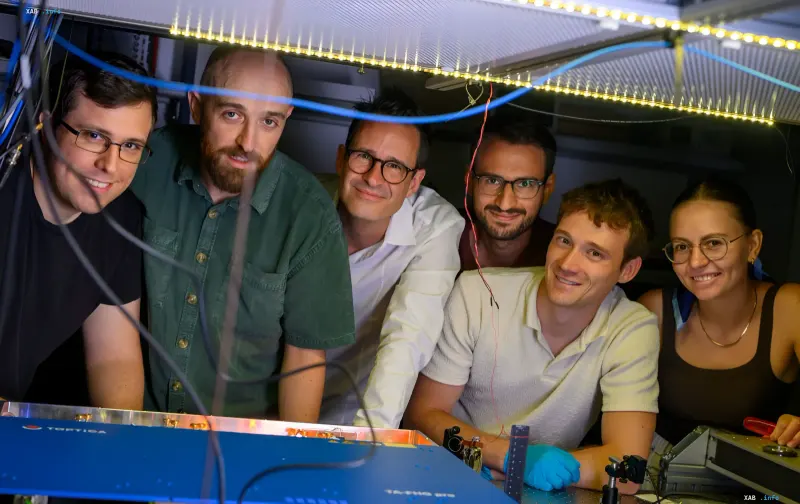
Scientists at the Vienna University of Technology (TU Wien) have presented a prototype of a nuclear clock capable of autonomously correcting its own errors and operating for more than a day without any external human intervention. The device, reported in a recent publication in the journal Nature, uses nuclear transitions of the thorium isotope as a time standard, which fundamentally distinguishes it from traditional optical atomic clocks based on electronic energy levels. According to RBC-Ukraine, the prototype's accuracy is on the order of 10 to the minus fifteenth power, which is equivalent to an error of one second over 30 million years of operation.
The Principle of Self-Stabilization: Why Thorium Became the Key to Reliability
Any laser clock measures time using a light beam; however, temperature, vibrations, and other external factors can cause the laser to slightly shift its working frequency, leading to the accumulation of error. To eliminate this problem, researchers placed a special crystal containing thorium atoms inside the device. The uniqueness of thorium, which has interested physicists for decades, lies in the fact that two of its nuclear energy levels are located incredibly close to each other. Thanks to this configuration, a laser beam can easily transition the nucleus from one state to another, and it is this physical phenomenon that ensures the self-stabilization of the system.
How the Clock "Hears" Laser Drift
The self-regulation mechanism works on the following principle: thorium nuclei absorb laser light only at a strictly defined frequency. If the laser begins to deviate from the norm, the light absorption intensity immediately drops. The clock detects this decrease and automatically corrects the laser's operation without requiring connection to any external reference devices. Thus, the device forms a closed feedback loop in which the thorium crystal itself acts simultaneously as both the measurement object and the calibration tool.
Why Nuclei Are More Reliable Than Whole Atoms
The researchers emphasize that the main advantage of the new approach lies in scale: atomic nuclei are more than 10,000 times smaller than whole atoms. This means they react much more weakly to external disturbances—electromagnetic fields, thermal fluctuations, mechanical impacts—making the entire system fundamentally more resistant to frequency drift. This is why the nuclear standard is seen as a potential successor to optical atomic clocks in ultra-precise timing tasks.
Current Limitations and Future Plans
Measurements taken over the course of a single day confirmed the prototype's accuracy at approximately 10⁻¹⁵. Although this result currently lags behind the world's best optical atomic clocks, for a first-generation device of this class, it is, according to the researchers themselves, exceptionally telling. In the future, the team intends to significantly increase accuracy by using more powerful lasers and thorium crystals with improved purity and homogeneity characteristics. The successful implementation of these plans could pave the way for a new generation of time standards for navigation systems, fundamental physics experiments, and the synchronization of global networks.