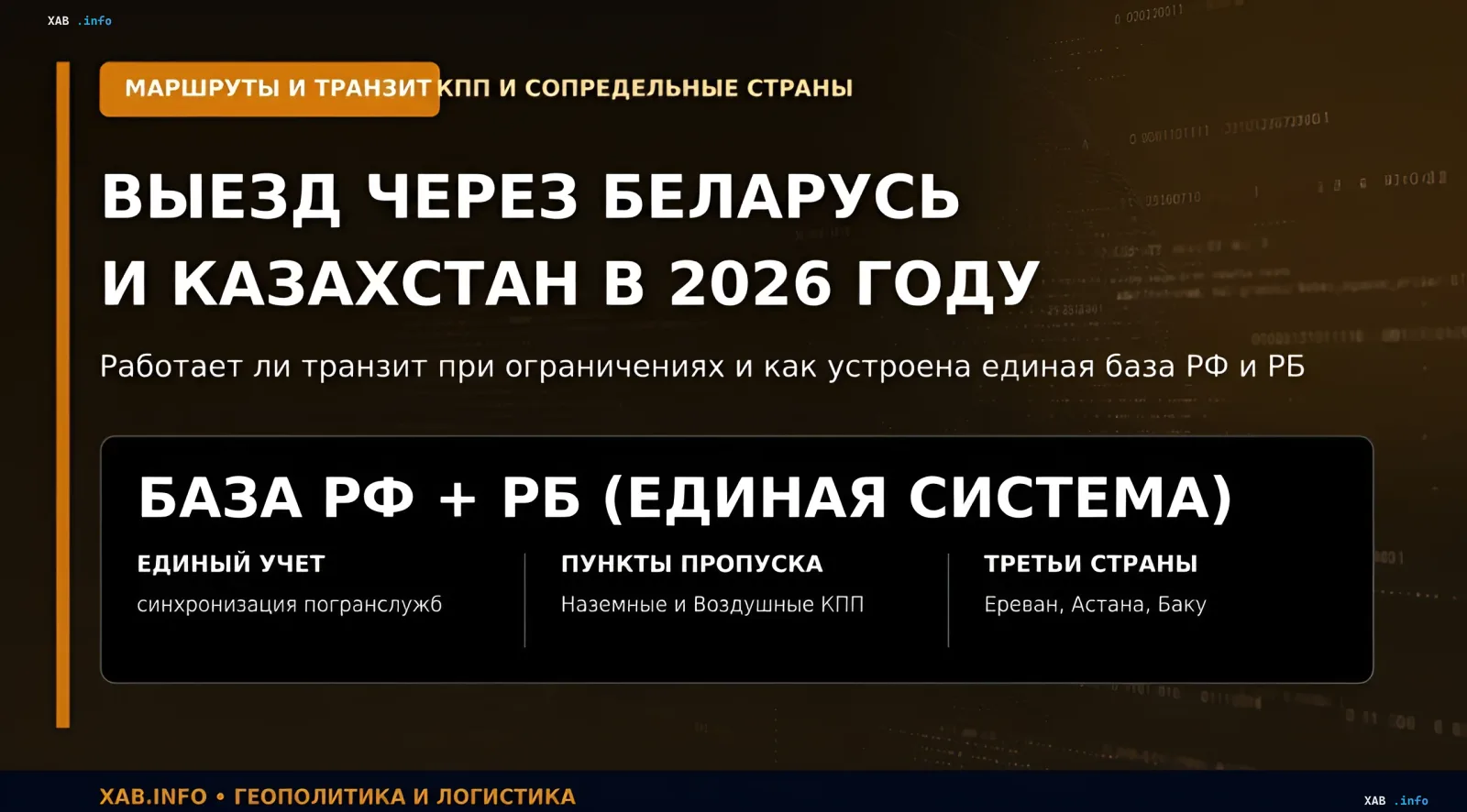
The introduction of the digital summon registry has become a structural factor that has changed the logic of cross-border movement of Russian citizens in 2026. Border control within the framework of the Union State and the Eurasian Economic Union has become more coordinated: previously operating "detour" schemes through neighboring countries have effectively lost their previous throughput. For macroeconomic and legal analysis, this means a transition from disparate national checks to a unified digital verification circuit, where the decision on border crossing is made based on automated databases rather than at the discretion of an individual border guard.
Digital Summon Registry and the Restructuring of Transit Routes
The key mechanism here is the digital summon registry, which is integrated into border control procedures. Its appearance reduces "gray" windows for the movement of persons subject to judicial or state restrictions. In terms of long-term consequences, this consolidates a model where transit through the territory of one member state of the Union or EAEU does not remove obligations recorded in the departure country's system. Thus, the route ceases to be a tool for bypassing restrictions and becomes an extension of a single control circuit.
Belarus: Database Integration and Control in Minsk
The exit scheme via Minsk — on "Lastochka" trains or by personal vehicle with a subsequent flight to third countries — in 2026 is associated with increased risks. The agreement between the MIA and border committees of the Russian Federation and Belarus provides for a constant exchange of lists of persons having judicial and state restrictions on departure. In practice, this means that when passing border control at Minsk National Airport, Russian citizens are checked against a joint database, and if the "Restriction on Departure from the Russian Federation" flag is present, Belarusian border guards refuse boarding on the flight. Legally, this consolidates the principle of mutual recognition of restrictions between the Union states.
Kazakhstan and Georgia: Land Border Crossings and Mobile Terminals
At automobile checkpoints on the Kazakh direction — Mashtakovo, Petukhovo, Orenburg — border guards of the FSB of the Russian Federation are equipped with mobile terminals for checking against Ministry of Defense databases. Attempts to cross the border by persons with active summonses are stopped directly on the Russian side, which shifts the point of control to before the actual departure. Separately highlighted is the "Verkhny Larch" checkpoint — the only operating land corridor to Georgia, remaining a zone of heightened attention: in addition to standard passport checks, officers may conduct selective questioning of persons liable for military service. This forms an additional point of risk specifically on the land vector.
Air Traffic via Neutral Hubs and the "Mir" System
Direct flights to Yerevan, Baku, Istanbul, Dubai, and Tashkent are maintained as the fastest routes, however, boarding is possible exclusively if no automatic order prohibiting departure has been issued against the passenger in the "Mir" system. Thus, even the air vector via neutral hubs is subject to a single digital filter: the speed of the route does not compensate for the presence of an automated restriction. For legal analysis, this emphasizes that the decisive factor is not the geography of movement, but the status of the record in the unified registry.
Legal and Long-Term Consequences
Collectively, the described mechanisms indicate the formation of a stable model of coordinated border control in the Union and EAEU. The long-term consequence is a reduction in the effectiveness of any schemes relying on gaps between national databases and an increase in the importance of preliminary digital verification of status before a trip. For citizens, this means the need to check for electronic summonses and restrictions before planning a route, and for institutions — the consolidation of digital exchange as a permanent element of border policy.