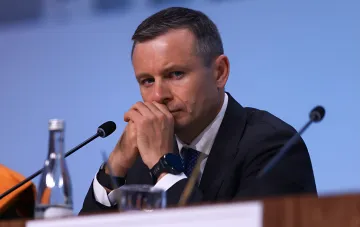
The State Treasury has suspended some payments to local communities amid a temporary cash deficit in its accounts. As explained by Bohdan Slutskyi, an expert at the Centre for Economic Strategy (CES), in an article for RBC-Ukraine, these delays can no longer be classified as a mere technical pause, though the situation does not yet indicate a full-scale public finance crisis. He describes it as an acute but temporary liquidity shortage: having expenses planned in the budget does not mean that the necessary funds are physically present in the account at any given moment.
Payment priority: who comes first and who waits
According to Cabinet of Ministers Resolution No. 590, the Treasury processes payments in strict order. The needs of the army, salary payments, and social obligations are funded first. Capital repairs, construction, and infrastructure projects are at the end of the line. As a result, communities with a significant volume of accumulated infrastructure projects are under the greatest pressure: a significant portion of capital expenditures planned for the first nine months of 2026 has been postponed to December. This creates a risk that a number of works will not be completed by the end of the year, and contractors working for communities may wait weeks for payment for work already completed.
International aid and "unpopular" reforms
The expert identifies the delay in receiving international financial aid as one of the key reasons for the budget gap. Part of the funding from international partners is tied to Ukraine fulfilling specific obligations, particularly the implementation of EU integration reforms. Slutskyi emphasizes that not all reforms linked to payments receive timely support in parliament, as some of them are complex and unpopular. He cites the unadopted Anti-Corruption Strategy for 2026–2030 (bill No. 15230-d), which is one of the conditions for activating the Ukraine Facility program, as an example. This program provides for long-term financial support for Ukraine from the European Union in the amount of 50 billion euros for the 2024–2027 period. Failure to meet the conditions leads to a delay in receipts, and the government is forced to postpone planned expenditures and restrict payments.
Impact on business and risks for next year
Treasury payment delays affect not only local budgets but also businesses working for communities. Contractors are forced to wait weeks for payment, even though they need to pay employees' salaries and finance current operating expenses. For small businesses, this means a reduction in working capital; in the long run, companies begin to factor the risk of delays into the cost of services, which makes repairs and other work for public institutions more expensive. The delays are already being felt in certain business support and housing loan programs. Budget risks for 2027 require special attention: according to the Ministry of Finance, Ukraine will need 52.5 billion dollars in external financing, and as of October 2026, 32.6 billion dollars of this amount remained unsecured. If the financial gap cannot be closed, local expenditures, repairs, and construction will again be under pressure.
Government reaction and possible solutions
On October 20, 2026, Prime Minister Serhii Koretskyi announced the unblocking of some expenditures, primarily for resilience plans, stating that the government had fulfilled all obligations and parliament had passed some of the necessary laws. Nevertheless, according to the CES expert, a sustainable reduction in pressure on the budget is possible only with the timely attraction of international aid through the fulfillment of obligations on which relevant payments depend. "That is, there is no avoiding difficult decisions. They are either made on time and the associated funding is received, or they are postponed, and then money is sought for already planned expenses," Slutskyi summarized. An alternative path is the reallocation of less priority civilian expenditures, but the possibilities for such a maneuver, according to him, are not limitless.