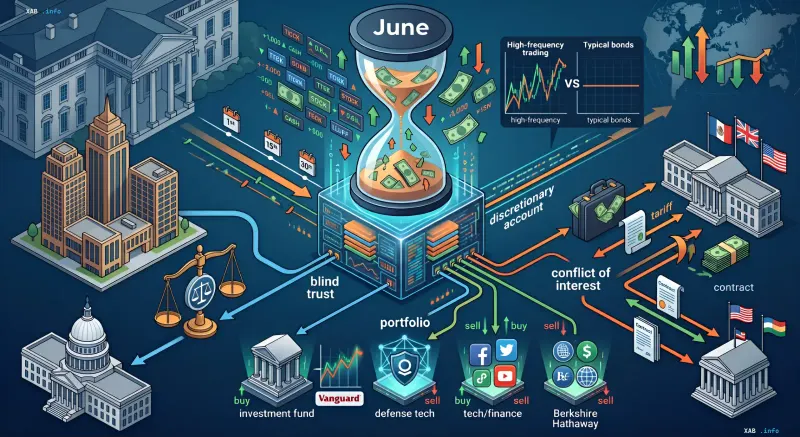
The financial disclosure filed with the U.S. Office of Government Ethics (OGE) and published by Bloomberg recorded more than 1,000 securities transactions on President Donald Trump's accounts in June 2026. The total volume of operations, as is customary in federal reports, is given in a range of $78.1 million to $263.1 million, which, over the 30 days of the month, corresponds to an average pace of more than 33 trades per day. The document confirms the continuation of an unprecedented level of intraday investment activity for a sitting head of state, which began back in 2025.
Scale and structure of June transactions
The largest single operation of the month was the sale on June 22 of shares in an exchange-traded index fund (ETF) from investment giant Vanguard Group, worth between $5 million and $25 million. In addition, the disclosure records a series of entries and exits from corporate issuers: on June 18, sales of $1 million to $5 million each were made in Berkshire Hathaway and Meta Platforms assets, with partial repurchase of smaller lots at the end of the month. Regular profit-taking and rebalancing of holdings were also carried out in Visa, Mastercard, Home Depot, Coinbase, and Cintas Corp. shares.
Key assets and temporal link to geopolitics
The most analytically contentious is the dynamics of the position in Palantir Technologies. At the beginning of the month (June 3), a block of shares worth $1,000–15,000 was acquired; on June 16, a sale of $15,000–50,000 was recorded; on June 18, a sale of $500,000–$1 million; and on June 23–24, a repeat repurchase. The last maneuver coincided with the period immediately after the June 14 peace agreement between the United States and Iran, which, according to observers, creates an apparent correlation between the foreign-policy event and the change in the position in the shares of the defense-technology contractor. It is precisely this temporal link that becomes the central argument of critics.
The White House position and the blind trust mechanism
White House spokesperson Davis Inglis and the president's son Eric Trump rejected allegations of insider trading and conflict of interest. According to them, all assets have been transferred to the discretionary management of a blind trust, and trades are generated by automated index algorithms replicating the Schwab 1000 basket, without any direct instruction, participation, or advance notice to the principal. Thus, from the administration's point of view, the president is unable either to influence execution or to know in advance the composition of individual transactions.
Contradictory data
The versions of the parties diverge significantly. The White House insists that "the president's investments are in a blind trust" and cannot be controlled by him, and therefore there is no conflict of interest by definition. Ethics experts, by contrast, point out that Trump has not sold his core business structures and continues to hold direct share blocks in companies dependent on government defense contracts, customs tariffs, and regulatory decisions. Moreover, federal reports provide ranges rather than exact figures ($78.1 million versus $263.1 million), which in itself does not allow for unambiguous verification of the final volume of June activity. Both positions — "full automation without influence" and "retention of conflicting direct positions" — remain in open contradiction and have not been resolved in any documented way.
Macroeconomic and regulatory context
To assess the scale, it is important to compare with predecessors: Barack Obama and Joe Biden held their assets primarily in U.S. Treasury bonds, whereas Trump declined full liquidation of assets into Treasury bills. In 2025, more than 21,000 transactions worth $600 million to $1.86 billion (about 57 trades per day) were registered in his name; in the first quarter of 2026, more than 3,700 trades worth $220–750 million (about 41 per day), with an emphasis on Big Tech (Nvidia, Microsoft, Apple) and bonds. June 2026, with its exit from the Vanguard ETF and speculation on Palantir and defense stocks, continues this series, but with a more pronounced link to geopolitical news.
Long-term consequences
The combination of an ultra-high trade frequency, the retention of direct positions in companies dependent on government contracts, and the rejection of the Treasury-bill model forms a lasting regulatory precedent. According to analysts, this increases pressure from oversight bodies and sets the stage for hearings in Congressional committees on government ethics. In macroeconomic terms, the key risk remains not so much the size of the portfolio as the market's perception of the possibility of trade signals coinciding with administrative decisions, which could undermine trust in the neutrality of the executive branch on issues of tariffs, defense procurement, and sanctions policy.