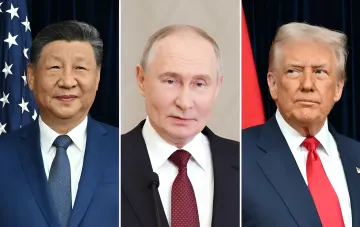
On Thursday, November 19, US President Donald Trump, during an unexpected phone call with European leaders, questioned the feasibility of continued multi-billion-dollar military aid to Ukraine. The calls reached a closed-door meeting of Kyiv's allies taking place in Berlin that day, and according to Politico, were made aboard the Air Force One aircraft — just a few hours after the US leader concluded a summit with Russian leader Vladimir Putin and Chinese President Xi Jinping in Shenzhen, China.
Calls Aboard Air Force One
According to Politico, the phone call was unplanned and improvised: Trump dialed in the middle of closed consultations among European capitals. The communication format — a voice call from the presidential plane — emphasized the urgency and personal nature of the message, which the American leader addressed directly to multiple heads of state rather than through diplomatic channels. The very fact that the conversation took place immediately after contacts with Putin and Xi Jinping, against the backdrop of discussions on the war in Ukraine, gives the call additional political weight.
Criticism of the "Coalition of the Willing"
As four knowledgeable European officials recounted, Trump sharply criticized the costs of supporting Ukraine and expressed skepticism regarding further aid to Kyiv by the so-called "Coalition of the Willing." One official present at the Berlin meeting noted that the US leader spoke in general terms and urged partners to stop funding the war, arguing, according to him, the high number of casualties. Thus, Washington did not officially change its formal obligations, but through a direct call signaled a shift in tone regarding European funding.
Statement on Putin's Readiness for Negotiations
During the same conversation, the head of the White House told European leaders that Vladimir Putin was supposedly serious about peace talks and ready to reach an agreement. At the time of publication, the White House had not officially commented on the phone call, leaving room for interpretation: European participants of the meeting received an assessment of Moscow's negotiating intentions from the US president, which is not yet backed by a joint statement or confirmation from the Kremlin.
Context of the Shenzhen Summit
Recall that on November 19, a bilateral meeting between Trump and Putin took place on the sidelines of the APEC summit in Shenzhen. At the beginning of the talks, the US leader called Putin his friend and expressed hope for a productive conversation. Following the meeting, the Kremlin stated that the parties discussed the war in Ukraine and bilateral relations, but the meeting ended without joint press statements. Russian presidential aide Yuri Ushakov assured that no major decisions were made at the bilateral level, as the leaders were preparing for a trilateral summit involving Chinese President Xi Jinping. It was in this context — without formal agreements, but with a personal signal to Berlin — that Trump's call to Ukraine's European allies took place.