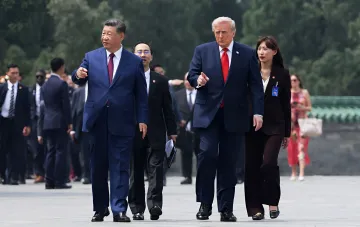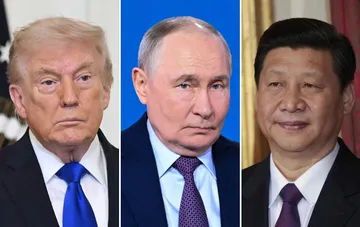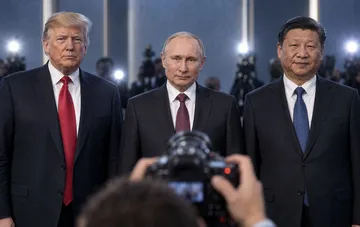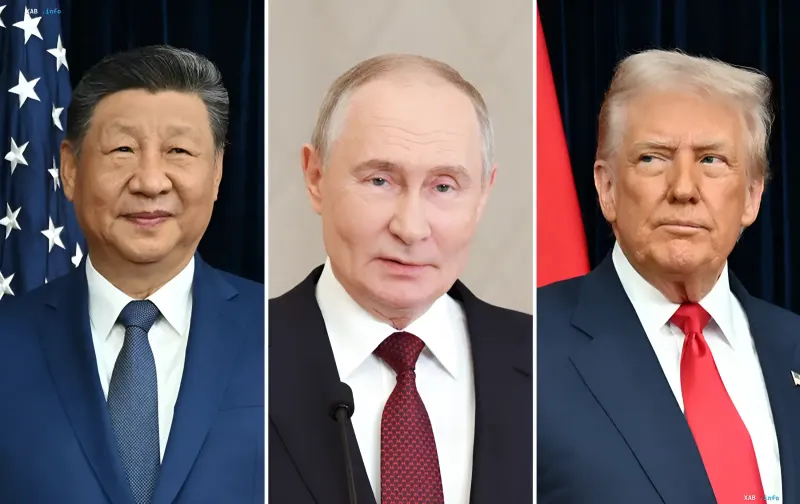
European capitals are experiencing a period of heightened diplomatic anxiety. According to Axios, citing several European officials and Western diplomats, Washington's allies fear that U.S. President Donald Trump may adopt a stance at the upcoming trilateral meeting with Vladimir Putin and Xi Jinping that could damage the interests of Ukraine and Europe. The main source of concern is the possibility that Trump might deviate from the agreed-upon negotiation script and make statements about Ukraine or Taiwan that would be perceived as support for Moscow and Beijing. “We know that every time President Trump talks to Putin or meets with him, it spells bad news for Ukraine and Europe. We are preparing for everything,” one European diplomat told Axios.
Contradictions in Washington's positions
The sharp shift in rhetoric from Washington has caused significant tension in Brussels, Berlin, and Kyiv. During a briefing on Friday, November 14, U.S. officials clearly emphasized that the war in Ukraine would not be discussed at the summit. Representatives of China had expressed a similar position. However, before departing for the Philippines on Monday, November 16, Trump himself declared: “We will talk about my favorite topic — Ukraine.” This statement effectively struck through the White House's previous signals and forced European partners to reconsider their expectations for the meeting. The originally stated goal of the trilateral summit was to begin discussions on nuclear disarmament, and it was this narrative that had been promoted in the official communication of all three sides.
'Yalta 2.0': Fear of spheres of influence
According to Axios, the upcoming summit was discussed behind closed doors during a meeting of European leaders in Dublin last week. Some participants expressed concern that the three-way meeting would create the impression of an agreement on carving the world into spheres of influence. Several of the publication's interlocutors explicitly referred to this scenario as "Yalta 2.0," recalling the 1945 conference that defined the post-war order in Europe. The question of potential statements by Trump was raised most actively by German Chancellor Friedrich Merz, who had previously publicly urged his American colleague not to stage any "surprises" during the meeting with Putin and emphasized that the U.S. must continue to act in coordination with Ukraine and Europe. Similar concerns, according to the report, were voiced by Ukrainian officials.
Parallel tracks: Berlin and Manila
Although U.S. representatives have attempted to downplay the significance of the summit and lower expectations for substantial results, European diplomats emphasize that any public rhetoric on the sidelines will be read by markets and capitals as a signal. Meanwhile, in Berlin, a meeting between Steve Witkoff, Jared Kushner, and Ukrainian and European representatives is scheduled for November 19 — the same day as the Manila summit. Key topics include security guarantees for Ukraine and its post-war economic reconstruction. Thus, two diplomatic tracks are operating in parallel on November 19: one in Manila on the sidelines of the Association of Southeast Asian Nations (ASEAN) summit, and the other in Berlin, where specific mechanisms for supporting Kyiv are being discussed.
Context and prospects
The summit of Trump, Putin, and Xi Jinping, expected on Thursday, November 19, on the sidelines of the ASEAN summit in the Philippines, is becoming one of the most anticipated diplomatic events of the fall of 2026. For Europe, the key issue is not so much the formal outcomes of the meeting, but rather the signals that will be sent to the market and allies in the first hours thereafter. According to Axios, European diplomats are preparing for a wide range of scenarios — from rhetorical gestures to concrete settlement proposals that might be perceived in Kyiv as pressure for concessions. In this situation, the parallel track in Berlin involving Witkoff and Kushner looks like an attempt by Washington to secure a “minimally acceptable” scenario with its allies before the statements from the Manila summit go public.