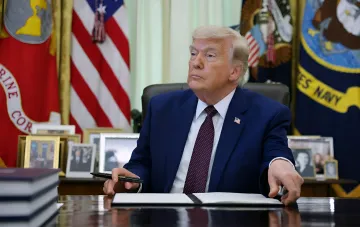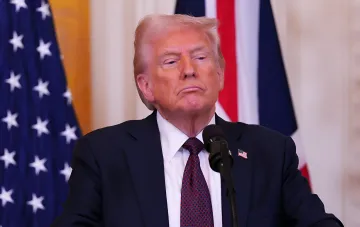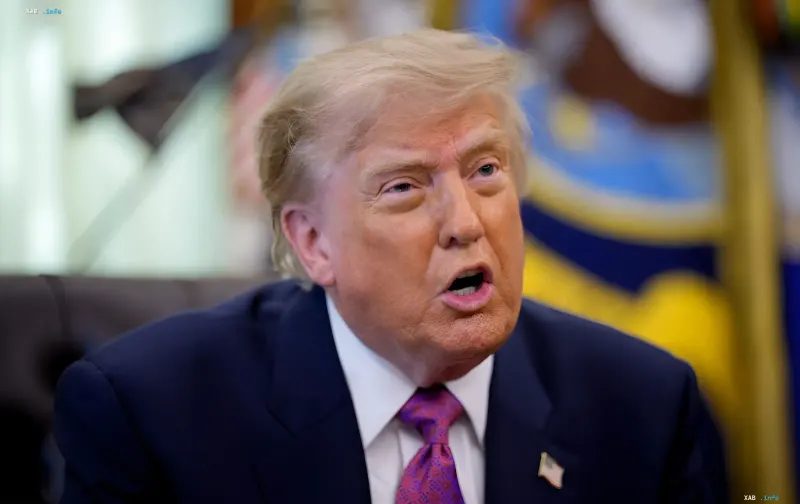
U.S. President Donald Trump, in an interview on Fox News, spoke positively about his recent phone conversation with Russian leader Vladimir Putin, which focused on resolving the conflict in Ukraine. According to the American president, the conversation took place in a constructive spirit and confirmed his readiness to work out agreements between the parties. This is reported by RBC-Ukraine, citing Trump's direct statements during the television show.
"He Wants to Make a Deal"
Trump described the conversation with Putin as "wonderful" and emphasized that, in his assessment, the Russian leader is interested in reaching an agreement. "He wants to make a deal. If Zelensky wants to make a deal, that would be very good," the U.S. president stated, thereby effectively shifting part of the responsibility for the possible breakdown of negotiations onto the Ukrainian side. At the same time, Trump added that both leaders — the head of Ukraine and the head of Russia — are "tired of fighting," which, in his view, creates the prerequisites for a compromise.
"Hate" as the Main Barrier
In response to a journalist's question about what exactly is preventing the signing of a peace agreement, Trump named the key obstacle as the "hate between Zelensky and Putin." This formulation sparked widespread resonance, as it reduces a highly complex geopolitical conflict to the personal relationship between two politicians and effectively excludes from the analysis the structural, economic, and military factors that determine the dynamics of the war. Nevertheless, the very fact that Trump publicly articulates such an assessment indicates his intention to position himself as an arbiter capable of "smoothing out" the personal contradictions between the parties.
Diplomatic Context: The CIA, a Trilateral Meeting, and Trade Promises
Trump's statements came against the backdrop of several significant diplomatic signals. Earlier, RBC-Ukraine reported that CIA Director John Ratcliffe could be given a significantly larger role in U.S. negotiations with Russia and Ukraine, indicating a shift of part of the negotiation process into an intelligence-analytical track. In parallel, news emerged of a possible imminent trilateral meeting at the highest level involving Trump, Putin, and Chinese President Xi Jinping. In addition, according to information from Putin's inner circle, Trump promised "impressive and far-reaching" prospects for trade between the United States and Russia in exchange for a swift end to the war against Ukraine.
Contradictory Data
The sources presented record a number of inconsistencies in the logic of the statements. On the one hand, Trump claims that Putin "wants to make a deal" and that both leaders are "tired of fighting," which implicitly suggests proximity to a deal. On the other hand, he points to the "hate" between Zelensky and Putin as an insurmountable obstacle, which contradicts the thesis of the parties' fatigue and readiness for compromise. Moreover, the promise of "far-reaching" trade prospects for Russia in exchange for ending the war creates a contradiction with the image of the United States as a neutral mediator: in effect, it is a question of providing economic incentives to one of the warring parties, which could be perceived as pressure on the other. Finally, in RBC-Ukraine's materials, Putin is consistently referred to as the "Russian dictator," reflecting the publication's editorial stance, whereas in Trump's quotes the neutral formulation "he" is used without evaluative labels.
Assessment and Outlook
Taken together, Trump's statements on Fox News paint a picture in which the American president seeks to cement his role as the key negotiator capable of "bringing" the parties to the table. The mention of the trade card with regard to Russia and the hint at personal "hate" as the main barrier suggest that Washington views the settlement less as a legal or military process than as a deal in which economic incentives and the personal dynamics between leaders play a decisive role. The reaction of Kyiv and Moscow to such formulations, as well as whether the announced trilateral meeting involving Beijing will take place, will become key indicators of how far diplomatic efforts have progressed at the current stage.