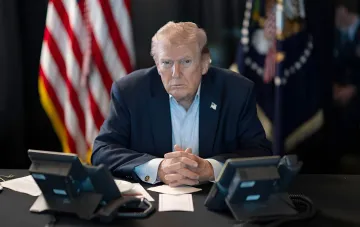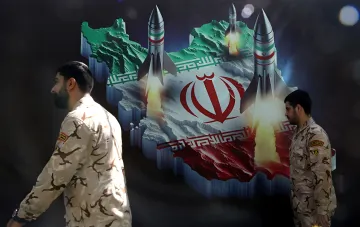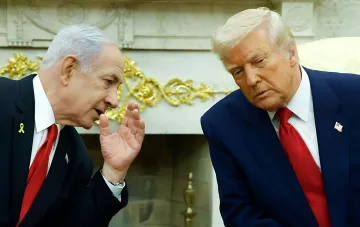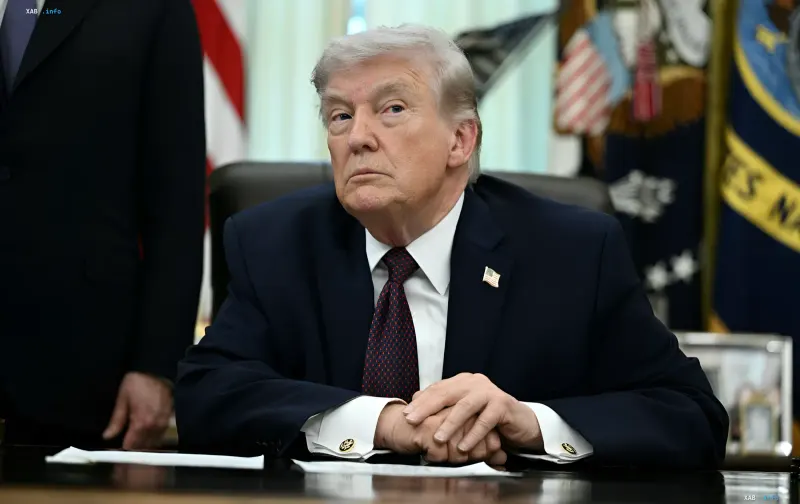
US President Donald Trump is considering resuming military operations against Iran to force Tehran back to negotiations. According to The Atlantic, the White House is already discussing several scenarios for new attacks, which could last anywhere from a few hours to a few weeks. The head of state has not yet made a final decision, but according to his advisers, a new round of strikes could begin shortly after the midterm elections.
Several Scenarios on the Table
Last week, US Defense Secretary Pete Hegseth and Chairman of the Joint Chiefs of Staff General Dan Kane presented Trump and Vice President JD Vance with several options for further military action. Admiral Brad Cooper, commander of US Central Command, which is responsible for operations in the Middle East, joined the discussion. Options include a short operation lasting a few hours, strikes lasting several days, or a prolonged campaign lasting weeks.
Hormuz Blockade as a Pressure Tool
A separate scenario involves maintaining the American naval blockade in the Strait of Hormuz. Washington could use it as a tool to pressure Tehran by threatening a resumption of hostilities, although Trump might forego such a step. Supporters of new strikes are convincing the president that economic pressure on Iran is already yielding results and that additional military action could force its leadership to the negotiating table.
Strikes on Infrastructure and Nuclear Facilities
One option involves a prolonged campaign against Iran's defense facilities — essentially returning to the approach the US used at the beginning of the war before reorienting strikes toward Iranian forces near the Strait of Hormuz. Attacks on Iranian infrastructure are also being considered, which Washington could justify by the dual-use nature of the facilities, although such strikes do not eliminate the threat to civilians and may violate international humanitarian law. Another scenario is a multi-day campaign against Iran's nuclear program. On November 1, Trump stated that the US had only one or two more Iranian sites left to deal with, the destruction of which, he said, would take just ten minutes; this most likely referred to the nuclear facility under Mount Kolang Gaz La, also known as Pickaxe Mountain.
Tehran's Reaction and Regional Risks
Iran's Supreme Leader Mojtaba Khamenei has reportedly ordered the military command to prepare for a possible resumption of confrontation with the US and Israel: expanding the list of potential targets so that American and Israeli facilities are within range, and strengthening the country's retaliation capabilities. A new operation could trigger a rise in global oil prices and create additional economic burdens for the US and its allies, while Iran's response would lead to a further expansion of the conflict.
Questions Left Unanswered by the Scenarios
None of the proposed options provide a clear answer regarding threats from Iranian allies in the region — primarily the Houthis in Yemen, who recently began attacking Saudi Arabia, even though eliminating such threats was one of the stated goals of the war. The White House also expects that the resumption of attacks could be supported by Israeli Prime Minister Benjamin Netanyahu, whose political future remains uncertain following the elections. One official spoken to by the publication linked Trump's recent shift in position on Ukraine to a desire to increase supplies of Russian energy to the global market to partially offset the consequences of possible actions in the Middle East. At the same time, part of the president's inner circle hopes that the mere threat of strikes will be enough to bring Iran back to negotiations, although such a tactic has repeatedly failed to yield the expected results.