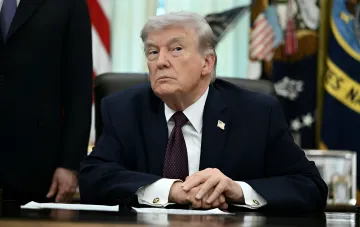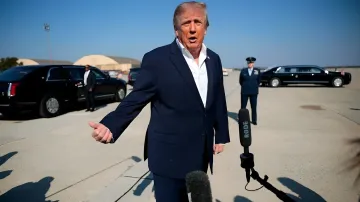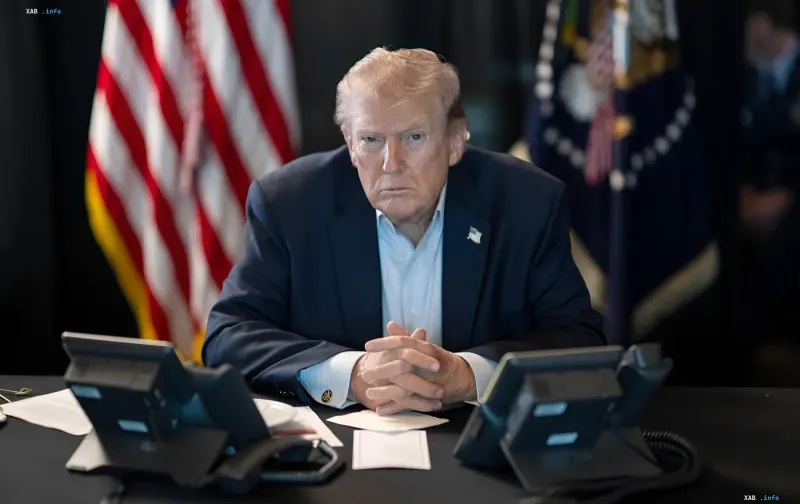
In an interview with Axios, US President Donald Trump stated that Washington sees no need to rush into resuming military actions against Iran. According to him, the American side has already caused serious damage to the Iranian economy, and the country's population is, in his estimation, "very tired" of the current situation. "One way or another, we will do something, but there's no rush. We blew up their economy. They have no money, no gasoline, and their people are very tired of it," Trump was quoted as saying by RBK-Ukraine. At the same time, the head of the White House assured that negotiations with Tehran are ongoing and going "well," and the Iranian side, in his opinion, is more interested in agreements than ever before.
Three Camps in Trump's Team
According to Axios, three camps with fundamentally different views on further steps regarding Iran have formed within the American president's inner circle. The first, the diplomatic camp, is supported by Vice President JD Vance and White House Special Envoy Steve Witkoff. They urge continuing negotiations and seeking an opportunity to conclude an agreement, arguing that resuming hostilities may not yield the desired result. According to the publication, the diplomatic path is also supported by the majority of Persian Gulf countries, which have already communicated their position to the US president.
The Military Option and Israel's Position
The second camp, insisting on a military solution, is represented by Israeli Prime Minister Benjamin Netanyahu and US Defense Minister Pete Hegseth. Their position is that Tehran cannot be trusted at the negotiating table or counted on to fulfill potential agreements. In their view, the US should end the confrontation by military means rather than relying on diplomacy. Earlier, according to The Atlantic, the Pentagon presented Trump with several scenarios for further action ranging from short strikes lasting a few hours to a large-scale campaign that could take weeks.
Economic Pressure Strategy
The third option is promoted by US Treasury Secretary Scott Bessent, CIA Director John Ratcliffe, and Secretary of State Marco Rubio. They advise against resuming hostilities, but also against rushing into a deal, maintaining the current situation and continuing economic pressure on Iran. In particular, Ratcliffe convinced the president that such a strategy could force Tehran to make major concessions, and the escalation of internal instability in Iran, by his assessment, could push citizens toward an uprising.
The Diplomatic Track Is Not Stopped
Parallel to internal political discussions, diplomatic contacts between the parties continue. On November 1, Qatari mediators completed another round of talks on ending the war, after which a new peace proposal draft began circulating. Thus, against the backdrop of three competing scenarios in Washington, the diplomatic channel remains active, and a final decision on the format of further confrontation with Iran, judging by Trump's statements, has not yet been made.