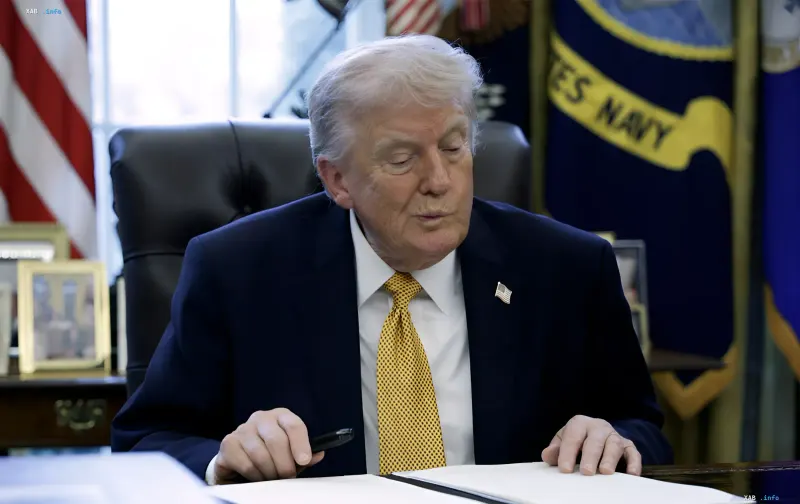
The White House is finalizing preparations for one of Washington's sharpest sanctions moves against Moscow. According to RBC-Ukraine, citing a statement by Radio Free Europe correspondent Alex Raufoglu, US President Donald Trump is set to sign the "hellish sanctions" law against Russia at 16:30 local time (23:30 Kyiv time). A White House official had earlier separately confirmed that signing the bill is scheduled. The document, dubbed the "hellish sanctions" law in the media, is aimed at the aggressor state and also covers Iran.
The bill's path through Congress
Before signing, the document went through the full congressional cycle. According to the data provided, on August 7 the US Senate approved the "hellish sanctions" against Russia and Iran: 86 senators voted in favor of the bill, authored by Lindsey Graham, while 11 voted against. After that, the House of Representatives of Congress finally adopted the same bill — at the final vote, 252 deputies supported the document against 154. Thus, only the signing stage remained before the president, turning the text adopted by Congress into a law in force.
Ukraine's sanctions policy and the scope of countries covered
Kyiv is actively tracking the preparation of the American package. Ukraine's Presidential Envoy for Sanctions Policy, Vladyslav Vlasyuk, publicly explained which specific countries and jurisdictions could be hit by the US "hellish sanctions," emphasizing their secondary, "cascading" nature: the restrictions can affect not only Russian entities, but also states and companies that continue to work with Moscow. This makes the package a tool of pressure on the entire orbit of Russia's partners, not just on the Russian Federation itself.
Beijing's reaction
China displayed an unexpectedly sharp reaction to Congress's adoption of the "hellish sanctions." The PRC authorities stated that the measures adopted by the US parliament against Russia have no legal basis and contradict international law. This position is important because China is one of Russia's key economic partners and a potential target of secondary sanctions; Beijing's public rejection of the law could complicate its practical application and become an element of diplomatic bargaining.
Contradictory data
There is a notable discrepancy between sources on the status and chronology of the signing. On the one hand, RBC-Ukraine (citing Radio Free Europe) frames the event as upcoming: Trump "will sign the law today" at 16:30 local time. On the other hand, a number of outlets are already reporting on a signing that has already taken place and quote expert reactions to the already-adopted document, i.e., they operate in the past tense. In addition, the text gives the date of Senate approval — August 7 — which does not match the wording "today" given the current publication date and may point to different stages of the process (vote vs. signing) or to a discrepancy in dates among sources. Until the official text of the signed law is released by the White House, the exact moment the document enters into force remains subject to clarification.
In any case, the totality of confirmed facts — Senate approval (86 to 11), adoption by the House of Representatives (252 to 154), and the White House's confirmed intention to sign the document — indicates that the "hellish sanctions" against Russia are moving from the bill stage to the stage of legislation in force. The main uncertainties remain the exact date of signing and the practical scope of the secondary restrictions, which, according to Ukrainian officials, could hit a whole range of countries.