
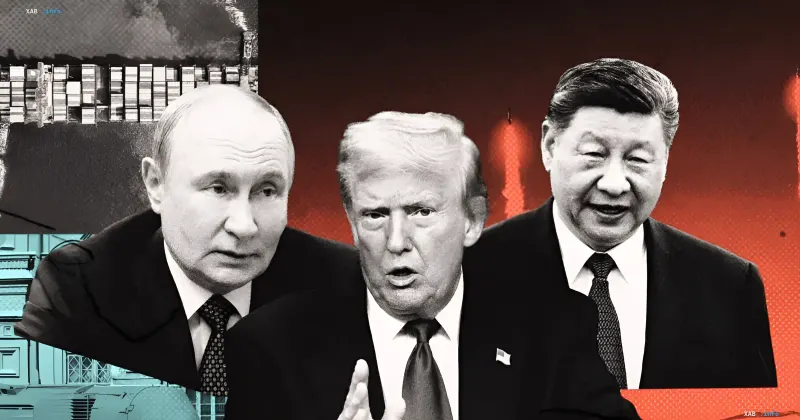
U.S. President Donald Trump has stated that Washington is in talks with Moscow and Beijing to advance denuclearization and establish control over the nuclear arsenals of the major powers. According to him, these discussions are taking place against the backdrop of the expiration of the Strategic Arms Reduction Treaty (New START), which, the publication assesses, increases pressure on the parties to find a new basis for nuclear arms control.
Statement in Newsmax Interview
In an interview with Newsmax, Donald Trump expressed his intention to move toward denuclearization and reported that the U.S. is holding relevant negotiations with both Russia and China. "I would very much like to do denuclearization, if that were possible. But actually, we're talking to Russia about that, and we're talking to China about denuclearization," the U.S. president stated. According to Newsmax, Trump also discussed the issue of denuclearization with Chinese President Xi Jinping. In the same interview, he suggested that China could "catch up" with the U.S. in nuclear potential within the next five years, reflecting Washington's growing concern over Beijing's role in strategic arms control agreements.
Context: Expiration of New START
Trump's statements came after the expiration of the Strategic Arms Reduction Treaty (New START) between the U.S. and Russia in early 2026. Signed in 2010, the treaty set limits on the number of deployed strategic nuclear warheads and their delivery systems and allowed for only a single five-year extension agreed upon by Presidents Joe Biden and Vladimir Putin. With the agreement's expiration, both countries are no longer bound by its restrictions, while bilateral relations continue to face numerous disagreements, and the international security environment develops in complex ways.
Nuclear Arsenals: SIPRI Data and the China Factor
According to the Stockholm International Peace Research Institute (SIPRI), Russia currently holds the world's largest stockpile of nuclear warheads, followed by the U.S. and China, although the U.S. has more deployed nuclear warheads than Russia. The disparity in arsenal sizes and the pace of nuclear development among the countries creates obstacles to establishing an arms control system encompassing all three major powers. Involving China in nuclear arms control discussions could further complicate the negotiation process: Beijing possesses a smaller arsenal than the U.S. and Russia but is expanding its nuclear capabilities, making the issue of maintaining strategic balance increasingly significant for Washington.
Obstacles and Prospects
According to Reuters, any new extension of restrictions would require issuing an executive order to voluntarily expand the treaty's framework, but available information does not indicate that the U.S. and Russia have reached a concrete agreement to restore or replace this framework program. President Trump's statement demonstrates an intention to promote dialogue, but does not mean the parties have agreed on objectives, a roadmap, or implementation mechanisms for denuclearization. The possibility of achieving substantial progress will depend on the willingness of the major powers to cooperate and on establishing verifiable commitments.