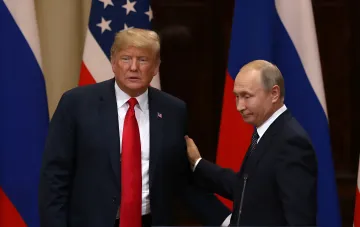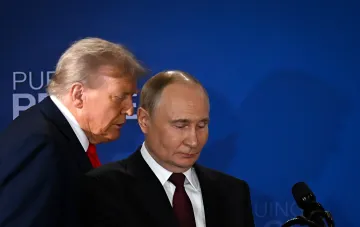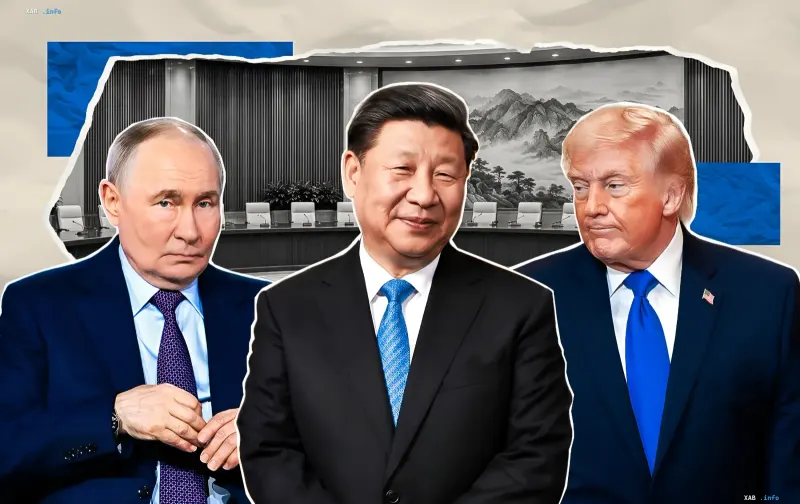
On November 19, on the sidelines of the APEC summit in Shenzhen, China, US, Chinese, and Russian leaders Donald Trump, Xi Jinping, and Vladimir Putin held a meeting. Just a few weeks ago, the expert community and social media were rife with fears that the trilateral summit would turn into a new 'Yalta' — drawing parallels to the post-war 1945 conference where heads of state laid the foundations of the international order for decades to come. However, as the meeting date approached, its actual agenda became much more down-to-earth, and expectations of 'grand deals' were replaced by the realization that each of the three leaders is primarily working for their own image and domestic political goals.
Format: Protocol Versus Open Discussion
Even regarding the format of the meeting, the parties could not reach an agreement. According to The Wall Street Journal, the Chinese side insisted on a strictly regulated summit: the reading of a pre-prepared joint statement and minimal space for free discussion. The Trump team, conversely, demanded a more flexible format allowing the three leaders to actively exchange views without being tied to ready-made talking points. Ultimately, as US officials and the South China Morning Post report, the focus will be on 'nuclear' issues where the parties are capable of reaching an agreement. At the same time, bilateral talks held on November 19 less than two hours before the trilateral summit proved far more important for the US and China.
Trump's Calculations: Image and Congress
The key domestic political context for the US president is his party's defeat in the midterm congressional elections, which automatically casts doubt on the implementation of any internationally reached agreement. Democrats will take control of one of the chambers in January, and Trump must manage to demonstrate successes on the world stage before that happens. Against the backdrop of a trade war that the US launched against several countries, including China—which is currently more frozen than finished—Beijing is using its monopoly on the processing of about 80% of the world's rare earth metals as leverage. Washington, in turn, has restricted the export of advanced microchips for artificial intelligence development. Further complications were introduced by the high-profile Nvidia scandal and the resignation of its longtime CEO Jensen Huang: an investigation into sanction evasion has completely unkenneled hawks in Washington who are demanding a total technological blockade of China. At the talks, Beijing is trying to secure easing of the chip embargo, but achieving this has become significantly more difficult.
Xi Jinping's Balance: The US Without 'Betraying' Russia and Iran
China seeks to improve relations with the US, yet it has no intention of doing so at the cost of 'betraying' Russia and Iran. On the morning of November 18, Xi Jinping and Vladimir Putin held restricted bilateral talks where, among other things, they touched upon the topic of Ukraine. This alignment of watches ahead of the trilateral summit underlines that Beijing is not ready to sacrifice its partnership with Moscow for the sake of rapprochement with Washington. For Xi Jinping, the priority remains the preservation of a multipolar architecture in which China acts as an equal pole rather than a junior partner to the US.
Putin's Stake: Weakening Isolation and Pressure on Ukraine
The Kremlin's goal at the meeting is to further weaken international isolation, convince Trump of the necessity to pressure Ukraine, and continue hostilities without introducing new sanctions. A personal meeting with Trump is important for Putin, with the agenda featuring the outcomes of recent consultations in Abu Dhabi and a number of bilateral projects. If the Russian leader extracts a format from the US and Chinese heads that even remotely resembles the Yalta Conference, it will become a symbolic victory for Moscow, emphasizing its status as a great power participating in the shaping of the global order.
The Only Real Outcome: AI Ban in Nuclear Weapon Command
Among the entire spectrum of discussed topics, analysts highlight one specific expected outcome of the trilateral meeting—an agreement to ban the involvement of artificial intelligence in the command of nuclear weapons. This is the only point on which, according to US officials and the South China Morning Post, the parties are capable of reaching a real agreement. The White House officially confirmed that Trump does not plan to discuss the Russia-Ukraine war at the trilateral summit, nor the issue of the Korean Peninsula's denuclearization. However, before flying to Asia on November 16, the US president personally shifted accents, stating that he intends to discuss, among other things, Russia's war against Ukraine. This layout emphasizes that the final agenda of the meeting remains fluid, and White House statements and Trump's personal remarks may diverge.
Impact on Ukraine: Scenarios and Risks
For Kyiv, the key question is whether the meeting in Shenzhen can become a platform for pressuring Ukraine in exchange for lifting sanctions or continuing hostilities without new restrictions. The Kremlin's calculation is built precisely on this: to convince Trump that pressure on Kyiv must intensify, and new sanctions against Russia must not be introduced. At the same time, neither China nor the US demonstrates readiness to assume security commitments regarding Ukraine within a trilateral format. Thus, for Kyiv, the Shenzhen summit is primarily an indicator that 'grand deals' on the Ukrainian track are not expected in the near term, and all three leaders are focused on their own domestic political and economic interests.