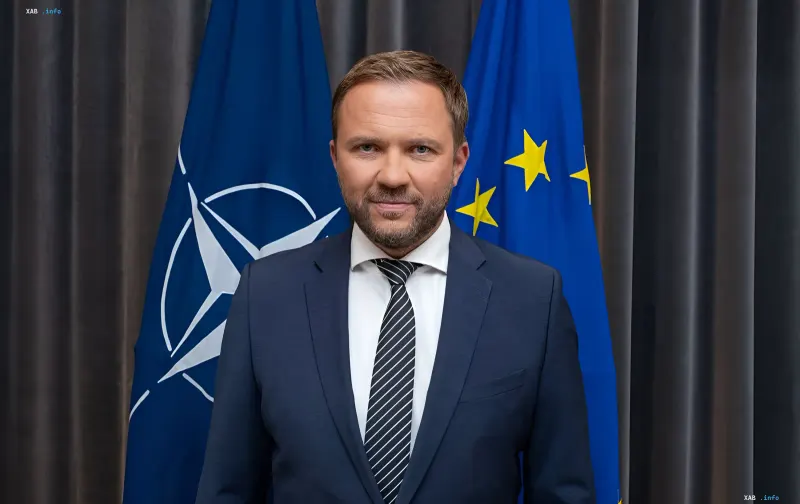
Estonian Foreign Minister Margus Tsahkna, in an opinion column for RBC-Ukraine, outlined the key theses of Tallinn's digital policy, drawing on two decades of practical experience: from the massive cyberattacks of 2007 to current challenges associated with autonomous artificial intelligence. According to him, Russia's war against Ukraine has finally reformatted the agenda: digital infrastructure is no longer exclusively a technological topic and has become a matter of national security and state survival. «Russia continues to use digital tools and cyberattacks as a fully-fledged weapon against civilian infrastructure and public administration», states the Estonian Foreign Minister.
The lesson of 2007: From crisis to institutional reform
Tsahkna recalls that Estonia first faced a systemic cyber threat in 2007, when the country was subjected to large-scale cyberattacks that paralyzed the work of banks, media, and state portals. This incident, in his estimation, showed that cyber threats are «not just technical incidents, but a matter of national security and foreign policy». Tallinn's response was institutional restructuring: in 2008, Estonia adopted the country's first Cybersecurity Strategy and created strengthened interagency coordination mechanisms under the auspices of the government. Since then, the minister argues, Estonia's digital policy has been built on the principle that technological openness cannot be separated from infrastructure resilience.
Eesti.ai: A pragmatic bet on artificial intelligence
The central element of Estonia's digital strategy today is the Eesti.ai program, which Tsahkna calls the country's «strategic choice». The program's ambitious targets include doubling the value of the Estonian workforce by 2035 through the introduction of AI into public administration and public services, increasing GDP by 25% within five years and by 50% within ten years. At the same time, the minister emphasizes a pragmatic, «non-utopian» approach: priority is given to verifying where autonomous systems can reduce paperwork, support civil servants, and increase productivity while keeping «control in human hands». A key challenge he highlights is shaping the development and deployment of autonomous AI in a way that enhances security and resilience without losing democratic governance.
The Tallinn Summit and a decade of digital dialogue
Over the past decade, the Tallinn Digital Summit, according to Tsahkna, has brought together governments, companies, and tech specialists to address issues that are now at the center of foreign policy debates: who controls critical digital infrastructure, how to regulate artificial intelligence, and how open societies can remain secure. «Estonia knows what it takes to build a digital state. Now we need to carry this experience into the next technological era», the minister formulates the task for the near future.
Ukraine's experience: Cyber defense as an ecosystem
Tsahkna links the practical verification of digital resilience theses to his visit to Kyiv in September 2026 at the head of a delegation of the Nordic-Baltic Eight (NB8). He describes how throughout the visit «air raid sirens wailed day and night», while Russian drones and missiles hit stores, gas stations, passenger trains, and residential buildings. At the same time, according to his observations, Ukrainian state bodies ensured the uninterrupted operation of services, maintaining citizens' trust and connection with the state even during attacks. Already in 2022, the minister notes, Ukraine demonstrated «extraordinary digital resilience», rapidly adapting existing digital services and developing new applications for wartime needs.
The Tallinn Mechanism: International cyber assistance to Ukraine
The main lesson Ukraine is teaching the whole world, according to Tsahkna, is that cyber resilience is more important than preventing every single attack: systems should be designed to withstand failures and continue performing critical functions even when integrity is compromised. The second lesson is that the state cannot independently defend its national cyberspace, and cyber defense is an ecosystem where the government, the private sector, and international partners act as a single entity. The minister illustrates Estonia's support for Ukraine through the «Tallinn Mechanism» — a framework of international cooperation to provide assistance in the field of civil cybersecurity, which has made it possible to combine public and private expertise to strengthen Ukraine's digital infrastructure.