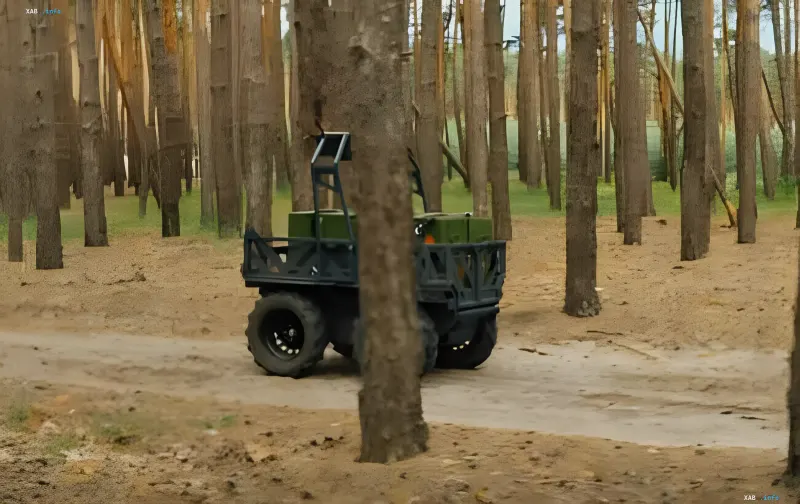
The Ukrainian military has reported the world's first combat deployment of a ground robotic complex (GRC) controlled by artificial intelligence. According to fighters from the 'Lava' Unmanned Systems Regiment of the 2nd National Guard Corps 'Khartia', the robot independently covered nearly 20 kilometers along a designated route without operator intervention. The experiment, the military specified, was conducted directly in real combat conditions rather than on a testing ground route.
How the Autonomous Route Works
Before the mission, the pathway was scanned using a laser sensor, and a three-dimensional model of the route was built based on it. During movement, the complex's cameras and sensors continued to recognize the road and obstacles, allowing the vehicle to adjust its trajectory in real time. According to the military, the key advantage of such an architecture is the ability to remotely control the GRC even during degraded communications or satellite internet failures involving Starlink.
Relieving the Operator's Workload
The introduction of AI, as explained by the fighters, allows the operator to focus less on direct vehicle control and pay more attention to external threats—primarily mines and enemy FPV drone ambushes. Thus, the autonomous module handles routine navigation while the human concentrates on situational awareness and decision-making under threat conditions.
Wounded Evacuation as a Priority Application
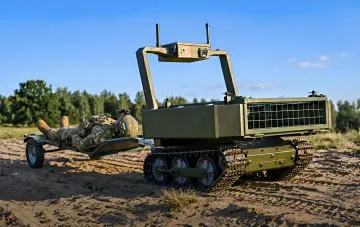
The military believes these complexes will bring the greatest benefit during evacuation missions. 'The greatest benefit they will bring is during evacuation missions. This is the greatest responsibility: when we transport a person, we need to have more chances to survive and get back,' the fighters noted. At the same time, according to their data, ground robotic complexes currently account for only about 0.3% of all medical evacuations on the front lines: the majority of the wounded are still evacuated by traditional means—on foot, armored vehicles, cars, all-terrain vehicles, and motorcycles.
Growth of Deployment in 2026
Despite their small share in the overall evacuation structure, the use of GRCs within Ukraine's Defense Forces is growing rapidly, according to the military: since the beginning of 2026, the number of missions by such complexes has increased 3.3 times. The peak occurred in August, when ground robots performed 25,143 logistical and evacuation missions—the maximum monthly figure since the beginning of the year. For comparison, 7,511 similar tasks were performed in January of the same year.
Context of Ground Robotics Development
The experience with the autonomous GRC fits into a broader trend of ground robotics development in Ukraine: earlier reports highlighted the creation of complexes with increased maneuverability designed for combat operations in underground pipelines. The current experiment with AI navigation on a 20-kilometer combat route, assessed by the military themselves, has become the next step in the transition from remotely piloted vehicles to partially autonomous platforms capable of operating under degraded communications.