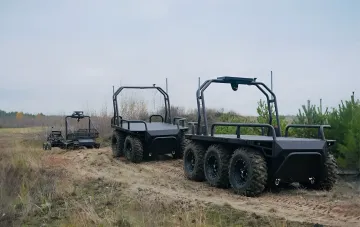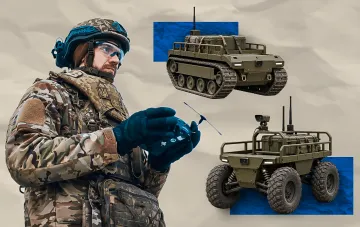
Ukrainian manufacturers of unmanned ground vehicles (UGVs) offer a sober assessment of their equipment's prospects on the front lines: in the near future, robots will not replace armored cars and pickup trucks, but they are already actively taking over a significant share of logistics tasks at the frontline. This was stated in an interview with RBC-Ukraine by the heads of Ratel Robotics and TechUnity, whose systems are used by Defense Forces units.
Redistribution, not replacement
Ratel Robotics CEO Taras Ostapchuk emphasized that the discussion about a "complete replacement of armored vehicles or pickups" is incorrect. According to him, it is about task redistribution: UGVs take on operations where using crewed vehicles creates unacceptably high risks for people. This is not a hypothetical future scenario—the process is already actively underway on the frontline. Ostapchuk predicts that by 2027, nearly all logistics near the combat contact line could be performed using unmanned ground vehicles. At the same time, armored vehicles will retain their niches: personnel transport, protected cargo transit, and operations on routes where speed and armor protection are critical.
The economics of retrofitting: why it's not that simple
A separate vector of development is retrofitting existing pickups and armored personnel carriers into unmanned systems. The CEO of TechUnity acknowledged in a comment to RBC-Ukraine that this is technically quite possible. However, the key question is economic feasibility. Retrofitting involves integrating remote control systems, additional electronics, safety mechanisms, and redundancy. In many cases, he estimates, it is simpler and cheaper to create a specialized UGV designed from the start for uncrewed operation than to modify serial armored vehicles. A mass demand for retrofitting heavy and bulky equipment from Defense Forces units has not yet formed: single integrations happen, but it is not a mass requirement.
International context: from Renault to ARMOLAB
The development of ground robotics for military tasks is not limited to Ukraine. Recently, Renault Group introduced the modular Forefront Concept UGV, built on proven automotive technologies and components. This is a signal that major automakers are beginning to perceive the unmanned ground platform as an independent product class. In parallel, the Ukrainian company ARMOLAB introduced the modular and collapsible UNIMOD ground robotic complex, designed for air dropping—a solution focused on rapid deployment in hard-to-reach areas.
What this means for the front line
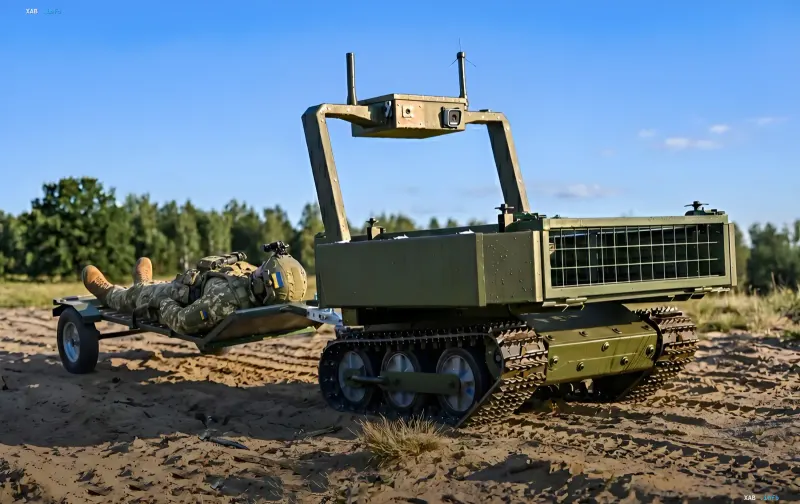
The combination of manufacturers' statements paints a picture of a gradual but steady transformation of frontline logistics. Robots do not come "instead" of humans in every link—they take on the most risky and routine tasks: ammunition delivery, wounded evacuation, route reconnaissance. Crewed armored vehicles remain where speed, firepower, and protection against direct hits are needed. According to experts, this hybrid approach will become the dominant model in the next two to three years, rather than in the distant future.