Unmanned Ground Vehicles (UGVs) within Ukraine's Defense Forces have transitioned from experimental prototypes to standard combat tools. According to RBC-Ukraine, in recent months unmanned ground platforms have been performing an increasingly wide range of missions: covering unit rotations, mining supply routes, and in some cases independently assaulting enemy positions. Leading UGV manufacturers — Ratel Robotics, TechUnity, UGVspace, and DevDroid — shared with the publication which designs will be in demand in the near future and how realistic the scenario of completely abandoning manned equipment on the frontline is.
Task Redistribution, Not Complete Replacement of Armored Vehicles
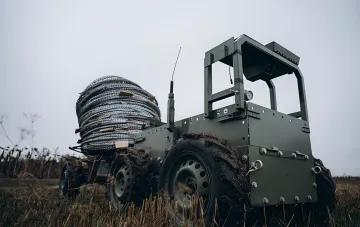
In previous RBC-Ukraine publications, industry insiders repeatedly stated that in the near future UGVs could replace manned "armor". However, the interviewed robotics manufacturers adjusted this formulation. Ratel Robotics CEO Taras Ostapchuk emphasized that today we are not talking about a complete replacement of armored vehicles or pickups. "First of all, we are talking about a redistribution of tasks," he noted. According to him, unmanned ground vehicles are already taking over a significant portion of frontline logistics, especially in sectors where using manned equipment creates unacceptably high risks for personnel. Ostapchuk predicts that by 2027 almost all logistics near the combat line could be performed using UGVs. At the same time, armored vehicles will retain their niches: transporting personnel, secure cargo transportation, and operating on routes where speed and armor protection are critical.
Wheels vs. Tracks: Choosing for the Task
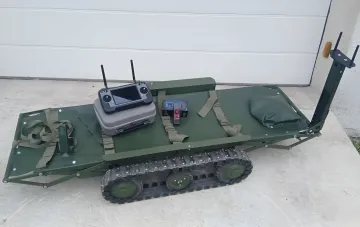
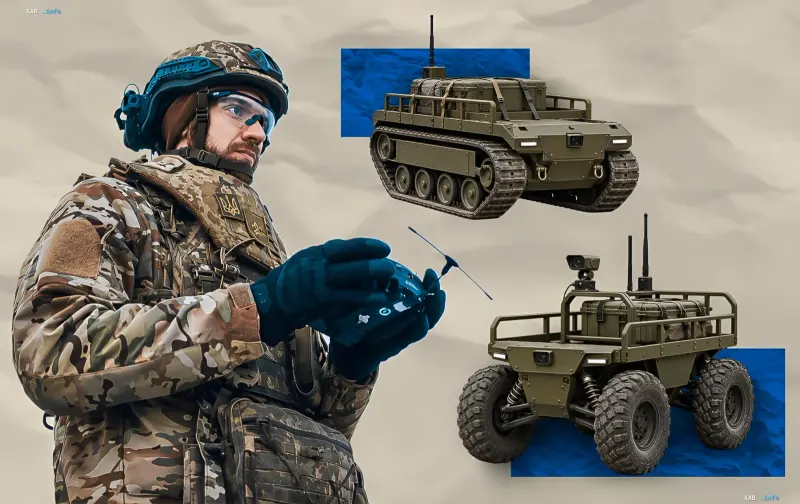
Developers emphasize that there is no universal platform equally effective in all conditions. Wheeled and tracked UGVs have fundamentally different strengths, and the choice between them is determined by specifics: the nature of the task, terrain, payload mass, and operating conditions. Tracked platforms provide better traction on rough terrain and in mud, while wheeled platforms win in speed on hard surfaces and operational maneuverability. The power plant is also selected for the mission: an electric drive is recognized as the optimal solution for most tasks due to silence, lack of exhaust, and ease of maintenance, yet for certain missions with a long autonomous operation mode, a gasoline engine remains preferable.
Economic Feasibility of Retrofitting
A separate vector of development is retrofitting existing pickups and armored personnel carriers into unmanned systems. The CEO of TechUnity acknowledged that technically this is possible: equipment of any size and complexity, down to buggies with an internal combustion engine and manual transmission, can be converted to remote control. However, in his assessment, in many cases it is easier and cheaper to create a specialized UGV originally designed for unmanned operation. Retrofitting requires the integration of remote control, electronics, safety, and redundancy systems, which significantly increases the project cost. Equipment covering the pickup weight segment has already been converted to remote control, and according to experts, the simpler path is to develop precisely this direction. Mass retrofitting of heavy and bulky equipment requires a steady request from the Defense Forces units; isolated integrations are already happening, but there is no mass demand yet.
The Kill Zone and Displacing Pickups in the 0–5 km Zone
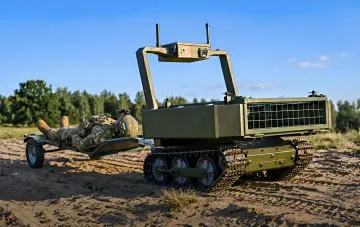
UGVspace records the practical displacement of pickups by UGVs in the zone from zero to five kilometers from the contact line. The logic is simple: a regular car at this distance is a guaranteed target for FPV drones, while a low-profile ground drone passes supply routes almost unnoticed. Furthermore, there are already UGVs capable of carrying hundreds of kilograms of cargo or evacuating the wounded in conditions where a pickup physically cannot reach. DevDroid CEO and co-founder Yuriy Poritsky added that a significant number of UGVs have already replaced armored vehicles with heavy machine guns: now robotic platforms with machine guns or grenade launchers operate instead of armed vehicles with crews. Poritsky links this to the continuous growth of the "kill zone" — the area where manned equipment becomes vulnerable — and emphasizes the need for solutions allowing the control of automotive and armored equipment from a safe rear post.
From Manual Control to Autonomy: The Technological Horizon
DevDroid is already working on relevant solutions: the company previously created the universal DroidBox control system, capable of integrating with any ground logistics platform regardless of the manufacturer. A number of other manufacturers are also working on retrofitting existing APCs and other vehicles with remote control systems, because "teaching" existing equipment is simpler and more cost-effective than purchasing ready-made specialized complexes. Overall, the industry is moving from fully manual control to the automation of individual processes — navigation, obstacle avoidance, route selection. In the future, ground drones will move to autonomous mission execution with minimal operator intervention. According to experts, this transition is no longer a question of a decade: the first elements of autonomous decision-making are being introduced into serial models right now.